Predators in Japan: What Predatory Animals Live Here?
Japan has no lions or tigers, and the wolves that once lived here are now extinct.
But Japan still has a surprisingly diverse range of predators.
Brown bears roam Hokkaido, foxes and martens live across the main islands, Mountain Hawk-Eagles hunt in forested mountains, and huge sea eagles gather in northern Japan during winter. Snakes also prey on small animals throughout the country.
On Iriomote Island, the rare Iriomote cat sits at the top of the local food web.
This guide looks at Japan’s predators from an ecological point of view—not simply at which animals are dangerous to people.
Japan’s seas also support many predators, including sharks and toothed whales, but this article focuses mainly on terrestrial and near-land wildlife.
What Predators Live in Japan?
Japan’s predators are not limited to large mammals.
Some of the best-known examples include:
- Brown Bear
- Asian Black Bear
- Red Fox
- Japanese Marten
- Japanese Weasel
- Iriomote Cat
- Tsushima Leopard Cat
- Mountain Hawk-Eagle
- Northern Goshawk
- Steller’s Sea Eagle and White-tailed Eagle
- Osprey
- Owls
- Japanese Rat Snake
- Japanese Mamushi
- Habu
One important point is that a predator is not necessarily a dangerous animal.
A predator is simply an animal that hunts or eats other animals.
For example, the Japanese Rat Snake preys on rodents, birds, frogs, and other small animals, but it is non-venomous and poses little danger to people.
Wild boars, on the other hand, can be dangerous in some situations, but they are not usually what we mean when talking about Japan’s main predators.
For animals that can pose a risk to people, see:
What Is the Largest Predator in Japan?
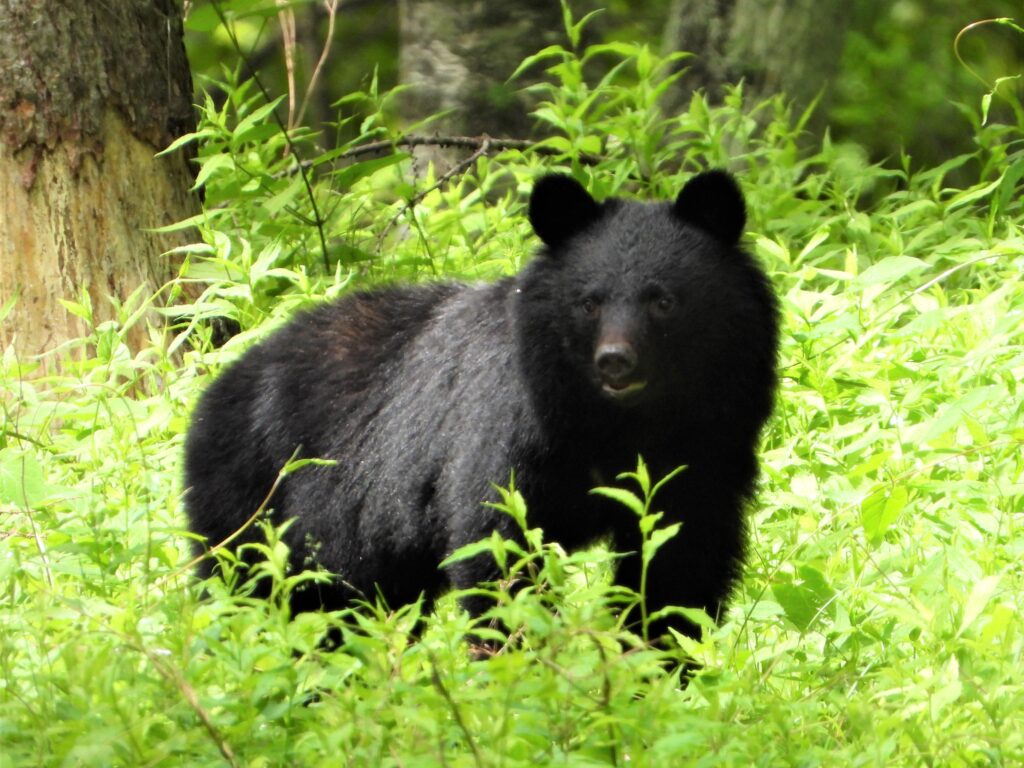
If we are talking about terrestrial predators, the largest is the Brown Bear (Ursus arctos) of Hokkaido.
Brown bears are the largest land mammals in Japan and will sometimes prey on other animals.
However, they are not specialized carnivores like lions or tigers.
They are omnivores, eating plants, nuts, insects, fish, and animal matter depending on the season and habitat.
So while the Brown Bear can be considered Japan’s largest terrestrial predator, it is better understood as a powerful omnivore than as a dedicated big-game hunter.
On Honshu and Shikoku, the Asian Black Bear (Ursus thibetanus japonicus) is one of the largest native mammals.
I have encountered wild bears in the Japanese mountains myself.
Seeing one in the wild feels very different from seeing one in a photograph. Their size and presence are immediately obvious, but viewing bears only as dangerous animals misses much of their actual ecology.
For a broader look at Japan’s largest wildlife:
Mammalian Predators in Japan

Japan has several mammalian predators besides bears.
Most are not especially large, but foxes, martens, weasels, and wild cats all hunt smaller animals in different habitats.
Red Fox
Red foxes occur across much of Japan.
Hokkaido is home to the Ezo red fox, while red foxes also live on Honshu, Shikoku, and Kyushu.
They hunt rodents, birds, insects, and other small animals, but they also eat fruit and other plant material.
I have seen wild foxes in Japan as well.
Their thick winter coats can make them look surprisingly soft, but foxes still spend much of their time searching fields and forest edges for small prey.
Japanese Marten
The Japanese marten (Martes melampus) is an omnivorous member of the mustelid family.
It eats fruit as well as insects and small vertebrates and is strongly associated with forests and forest edges.
It is one of Japan’s characteristic small carnivorous mammals.
Japanese Weasel
The Japanese weasel (Mustela itatsi) feeds on a wide range of prey, including rodents, frogs, birds, insects, fish, and crustaceans.
It is also often associated with rivers, wetlands, and other waterside habitats.
Martens and weasels are easy to overlook, but both are important parts of Japan’s food webs.
For more Japanese mammals:
Iriomote Cat
One of Japan’s most unusual predators is the Iriomote cat.
This extremely rare wild cat is found only on Iriomote Island in Okinawa Prefecture.
Although it is not a large animal, it sits at the top of the island’s food web.
That makes it a good example of why there is no single “apex predator of Japan.”
In a small island ecosystem, even a relatively small wild cat can occupy the highest predatory position.
Tsushima Leopard Cat
Tsushima Island is home to another rare wild cat: the Tsushima leopard cat.
It hunts small mammals, birds, and other animals and is an important native predator on the island.
Neither the Iriomote cat nor the Tsushima leopard cat is easy to see in the wild.
Birds of Prey Are Important Predators Too
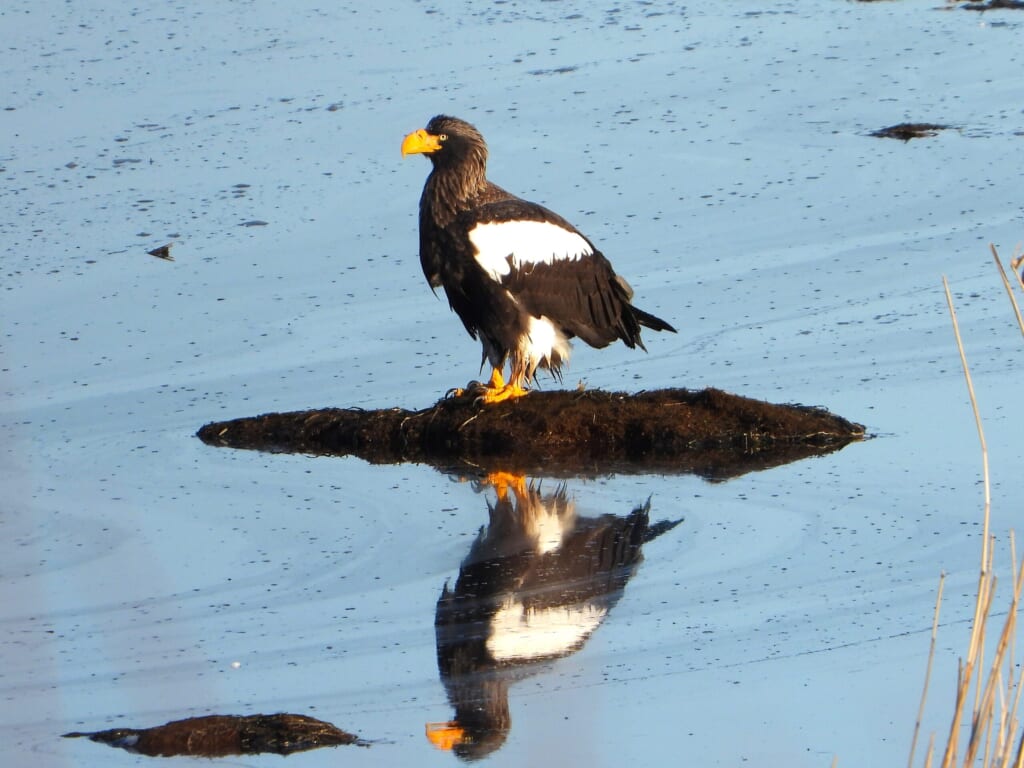
Some of Japan’s most impressive hunters are found in the sky.
Eagles, hawks, ospreys, and owls hunt across forests, grasslands, wetlands, rivers, and coastal areas.
Mountain Hawk-Eagle
The Mountain Hawk-Eagle (Nisaetus nipalensis) is one of Japan’s most powerful forest raptors.
It hunts a wide range of prey, including birds, flying squirrels, squirrels, snakes, and other forest animals.
One of my most memorable encounters was with an adult Mountain Hawk-Eagle at a small lake deep in the mountains.
I first heard it calling from the forest on the opposite side before finally finding it. On another occasion, I also saw a juvenile.
Seeing such a large raptor moving over deep Japanese forest makes it clear that these mountain ecosystems still support formidable hunters.
Steller’s Sea Eagles and White-tailed Eagles
Winter in Hokkaido brings some of Japan’s largest birds of prey.
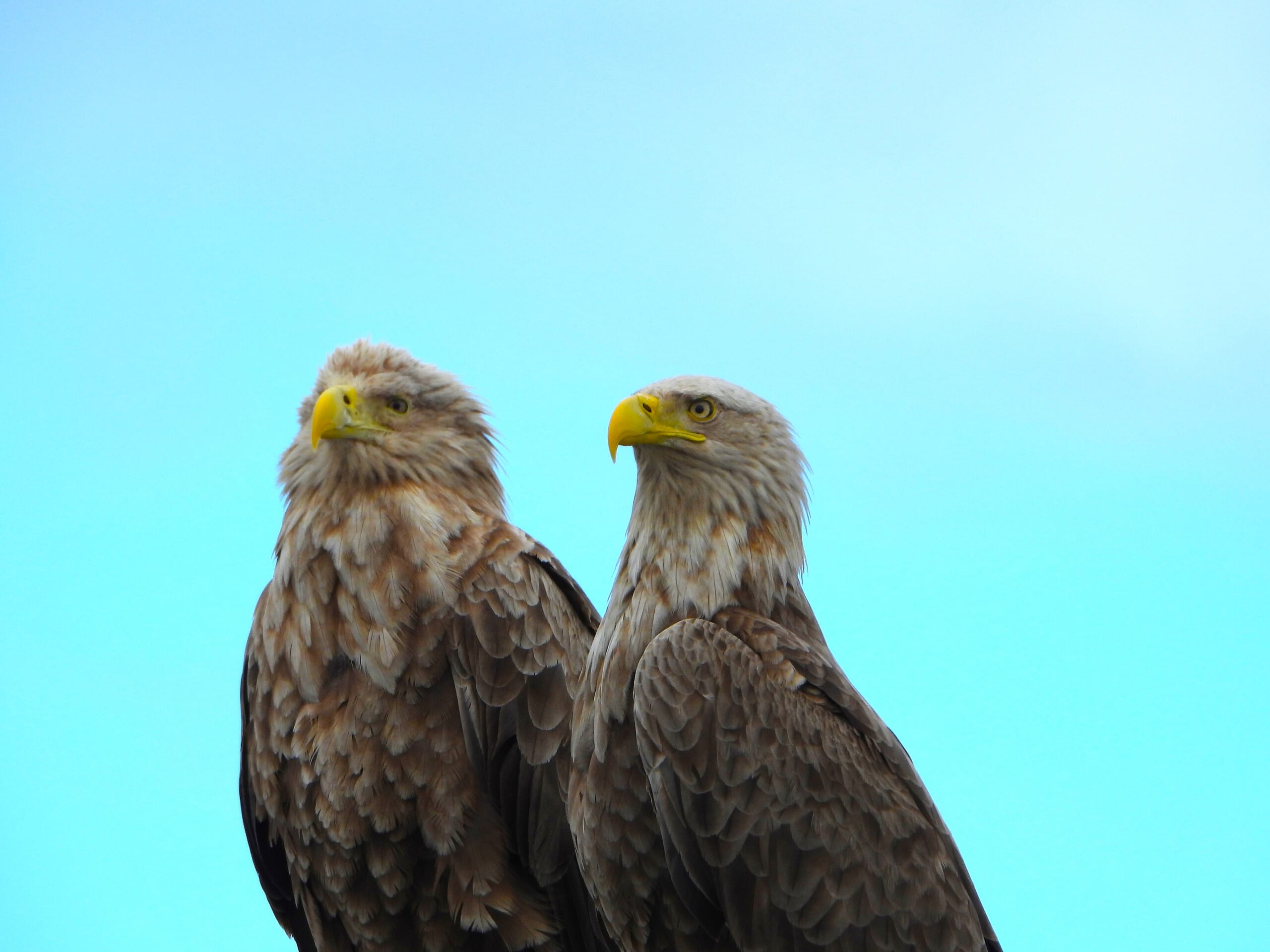
Steller’s Sea Eagles and White-tailed Eagles gather in northern Japan during the colder months.
I have photographed both species several times in Hokkaido, including on the Notsuke Peninsula.
They are so large that, in the right wintering areas, they can be surprisingly easy to spot even when perched far away.
Steller’s Sea Eagles in particular stand out because of their enormous bills and massive build.
Other Birds of Prey
Japan also has Northern Goshawks, Ospreys, owls, and many other predatory birds.
Their hunting styles vary considerably.
Northern Goshawks use speed and surprise to catch birds and other prey, while Ospreys specialize in catching fish.
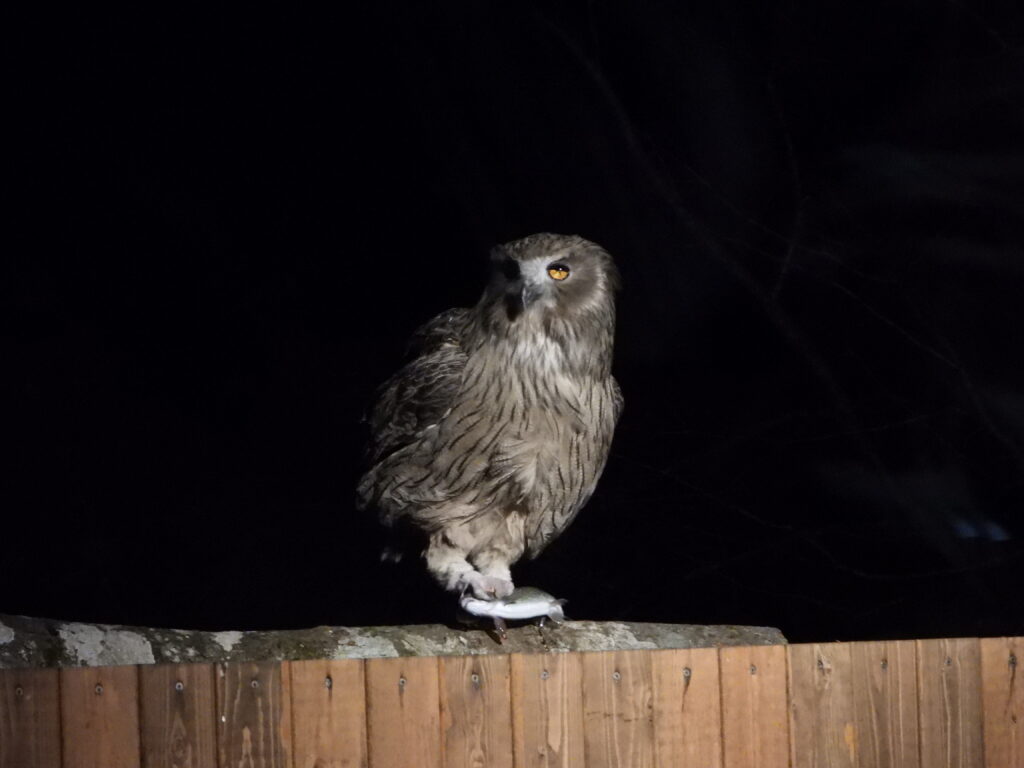
Owls take over after dark. Some species mainly hunt small mammals, while Blakiston’s Fish Owls in Hokkaido rely heavily on fish.
Birds of prey are a major subject on their own, so here they are best viewed as one important part of Japan’s wider predator community.
Snakes Are Predators Too
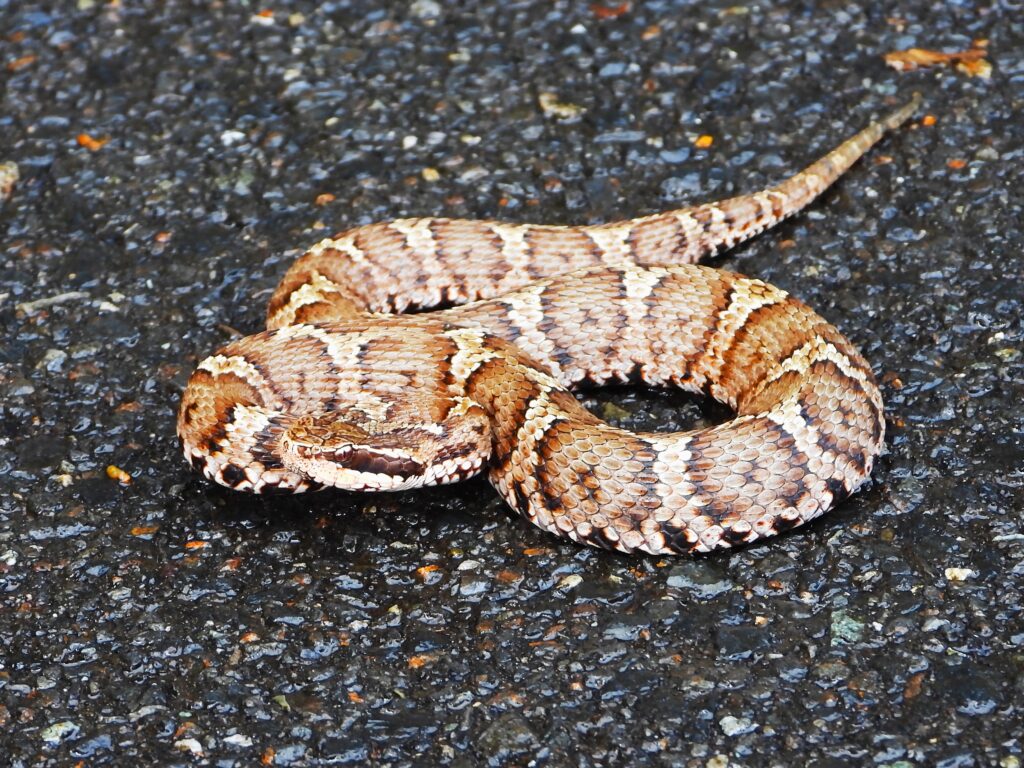
Many Japanese snakes survive by hunting small animals.
Depending on the species, their prey can include rodents, frogs, lizards, birds, and other vertebrates.
Japanese Rat Snake
The Japanese Rat Snake is a large non-venomous snake found widely in Japan.
It feeds on rodents, birds, frogs, and other small animals and is also an excellent climber.
Because it is non-venomous, it rarely appears on lists of Japan’s dangerous animals.
Ecologically, however, it is a clear example of a native predator.
Japanese Mamushi
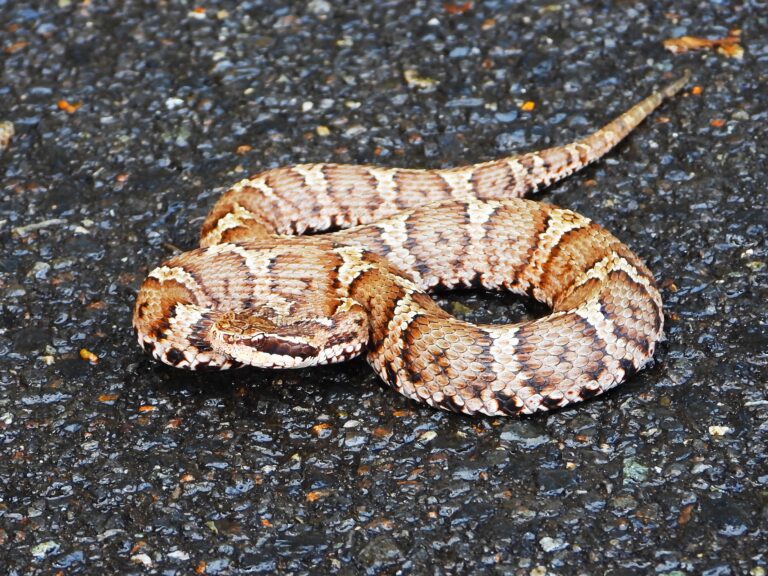
The Japanese Mamushi (Gloydius blomhoffii) is one of Japan’s best-known venomous snakes.
Its danger to humans gets most of the attention, but ecologically it is simply another native hunter.
It preys on small mammals, frogs, reptiles, and other animals.
Habu
In Japan’s southern islands, Habu and related pit vipers are important predators.
Habu feed heavily on wild rodents and also take birds, lizards, and frogs.
I have encountered Habu myself in the mountains of Amami Oshima.
One individual was wrapped around a tree branch and blended into its surroundings so well that it would have been easy to miss.
It is certainly a dangerous venomous snake, but it is also a natural part of the island’s food web.
For more on Japan’s snakes:
What Happened to Japan’s Wolves?
There are no wild wolves left in Japan today.
Japan once had two forms: the Japanese wolf (Canis lupus hodophilax) and the Ezo wolf (Canis lupus hattai).
Both are now considered extinct.
That means Japan no longer has a large wild canine predator comparable to the wolves found in parts of Europe, Asia, and North America.
The ecological effects of their disappearance are complicated.
It is tempting to explain modern deer populations simply by saying that wolves disappeared, but wildlife populations are also shaped by land use, hunting pressure, forest conditions, food availability, and many other factors.
The important point here is simpler:
Japan once had large native canine predators. Today, it does not.
Does Japan Have Apex Predators?
Yes—but there is no single apex predator for the entire country.
Japan stretches from the cold forests of Hokkaido to the subtropical islands of the southwest, and its ecosystems differ greatly from region to region.
Hokkaido has Brown Bears.
Mountain forests on Honshu support large raptors such as the Mountain Hawk-Eagle.
On Iriomote Island, the Iriomote cat is recognized as an apex predator.
The Crested Serpent Eagle is also one of the island’s top predators.
So rather than asking:
“What is the apex predator of Japan?”
it makes more sense to ask:
“What is the top predator in this particular Japanese ecosystem?”
The answer changes depending on where you are.
Are Predators in Japan Dangerous to Humans?
Not necessarily.
Foxes, martens, many birds of prey, and non-venomous snakes all hunt other animals, but they do not regard humans as prey.
Some species can still be dangerous in certain situations, especially bears and venomous snakes.
For safety advice and animals that pose a real risk to people, see:
Where Can You See Predators in Japan?
The mix of predators changes considerably from north to south.
Hokkaido has Brown Bears, Ezo red foxes, Steller’s Sea Eagles, and White-tailed Eagles. Eastern Hokkaido is especially interesting in winter for large raptors.
Honshu has Asian Black Bears, red foxes, martens, weasels, Mountain Hawk-Eagles, Northern Goshawks, owls, and many snake species.
Japan’s southern islands have very different predators, including Habu. Iriomote Island is home to both the Iriomote cat and the Crested Serpent Eagle.
Rare species should never be treated as animals you can expect to see simply by visiting the right island or region.
For a broader guide to finding wildlife around Japan:
Japan Still Has Plenty of Predators
Japan has no lions or tigers, and its native wolves are gone.
But predators are still found throughout the country.
Hokkaido has Brown Bears and giant sea eagles. The forests of Honshu support foxes, martens, and Mountain Hawk-Eagles. In the southern islands, Habu and the Iriomote cat occupy very different roles in the food web.
Smaller hunters such as weasels, goshawks, owls, and snakes are found across many parts of Japan as well.
What makes Japan’s predator community interesting is that there is no single giant carnivore sitting at the top everywhere.
Snowy Hokkaido, the mountain forests of Honshu, and the subtropical forests of Iriomote all support different predators.
After looking for wildlife across Japan, I think that regional variation is one of the most fascinating things about the country’s wildlife.