Where to See Sea Eagles in Hokkaido: Steller’s & White-tailed Eagles
If you want to see Steller’s Sea Eagles and White-tailed Eagles in Japan, eastern Hokkaido is the place to go.
The best areas are Rausu and Shiretoko, Nemuro and Lake Furen, and the Notsuke Peninsula.
For the best overall chance of seeing both species, January and February are especially good months. If your goal is to see sea eagles with drift ice, February is usually the strongest option around Rausu.
And no—you do not need to take a cruise to see them.
Sea eagles can also be found from land around Nemuro, Lake Furen, Shunkunitai, and the Notsuke Peninsula.
I have watched and photographed both species in Hokkaido myself, including on the Notsuke Peninsula.
From my experience, they are not exceptionally difficult birds to find if you visit the right wintering areas and give yourself enough time. Both species are huge, so they often stand out even at a distance.
This guide focuses on the practical side of sea eagle watching in Hokkaido: where to go, when to visit, how to tell the two species apart, and whether you really need a boat trip.
Where Are the Best Places to See Sea Eagles in Hokkaido?

For a first sea eagle trip to Hokkaido, I would focus on three main areas:
- Rausu and Shiretoko – best known for drift ice and winter sea eagle cruises
- Nemuro and Lake Furen – excellent for searching from land
- Notsuke Peninsula – an important wintering area for large numbers of sea eagles
Each offers a slightly different experience.
Rausu is famous for winter cruises, while Nemuro and Notsuke are better suited to driving between coastal areas, lakes, bays, and open landscapes while searching on your own.
In other words:
Sea eagle watching in Hokkaido does not mean Rausu cruise only.
If you want eagles on drift ice, Rausu is the obvious choice.
If you prefer finding birds from land, Nemuro and Notsuke give you many more options.
What Is the Best Time to See Sea Eagles in Hokkaido?
Winter is the best season if you want to see both Steller’s Sea Eagles and White-tailed Eagles.
For most wildlife travelers, January and February are the strongest months.
January
By January, sea eagles are already well established in eastern Hokkaido.
Steller’s Sea Eagles are especially numerous around Rausu during January and February.
Drift ice may not yet have reached Rausu, but that does not mean the eagles are absent.
If your main goal is simply to see the birds, January is already an excellent time to visit.
February
If you want to combine sea eagles with drift ice, February is usually the most attractive month.
When drift ice enters the Nemuro Strait, Steller’s and White-tailed Eagles may use the ice as resting platforms.
The sight of a huge Steller’s Sea Eagle standing on sea ice is one of the classic wildlife scenes of winter Hokkaido.
However, drift ice is never guaranteed.
Its timing and position depend on wind, ocean currents, and seasonal conditions. Some years it arrives later or remains farther offshore.
So it is better not to plan your trip around the assumption that:
“February automatically means eagles on drift ice.”
The eagles may be there even when the ice is not.
March
Sea eagles can still be seen in early March.
However, Steller’s Sea Eagles gradually begin moving north again as spring approaches, so the main winter season is starting to wind down.
For a first dedicated sea eagle trip, I would personally focus on late January through February.
How Can You Tell a Steller’s Sea Eagle from a White-tailed Eagle?
Adult birds are usually quite straightforward to separate.
Both are enormous, so size alone is not the best identification feature.
At a Distance, Look at the Bill First
If I see a large eagle sitting far away, the first thing I look at is the bill.
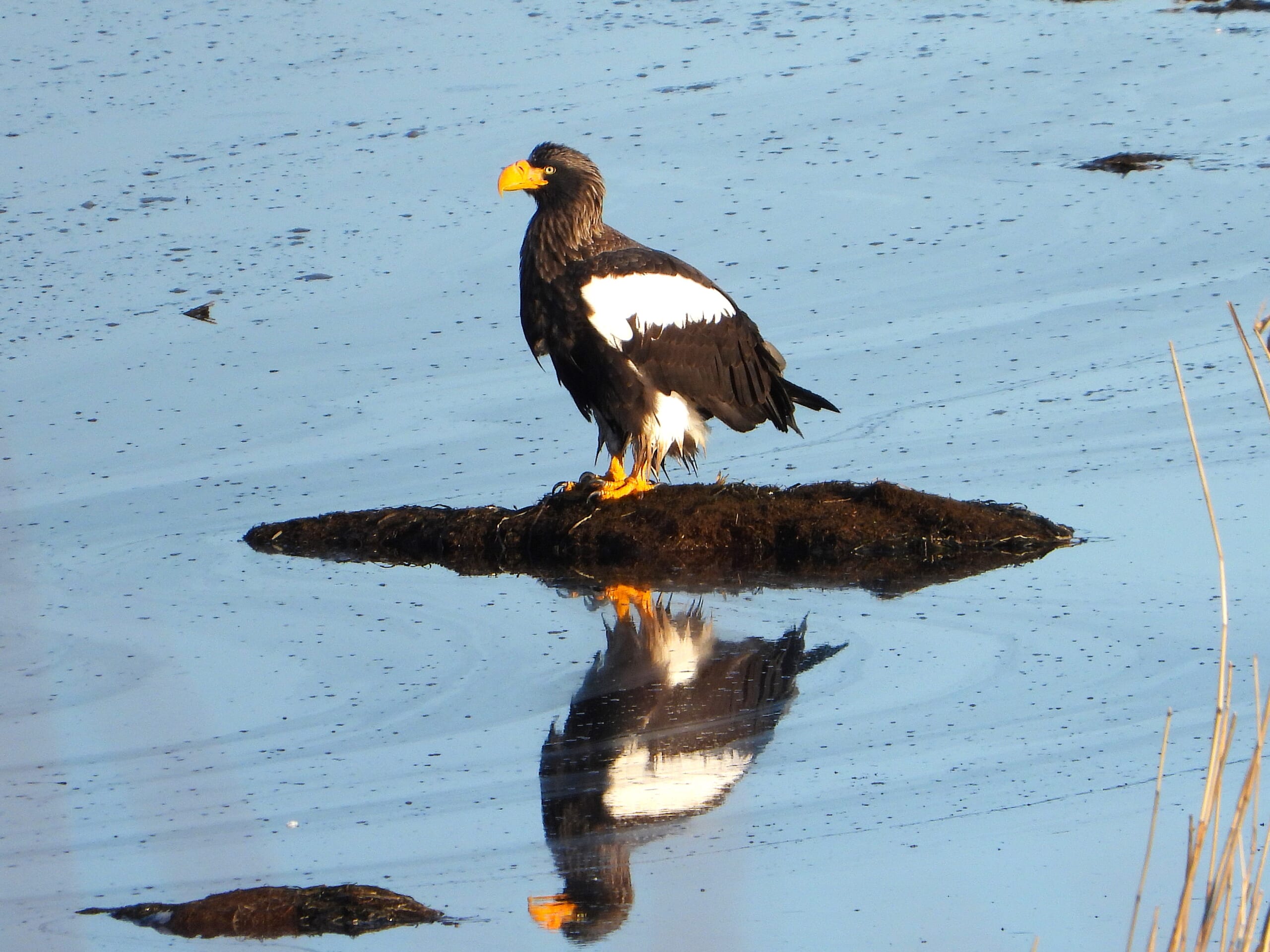
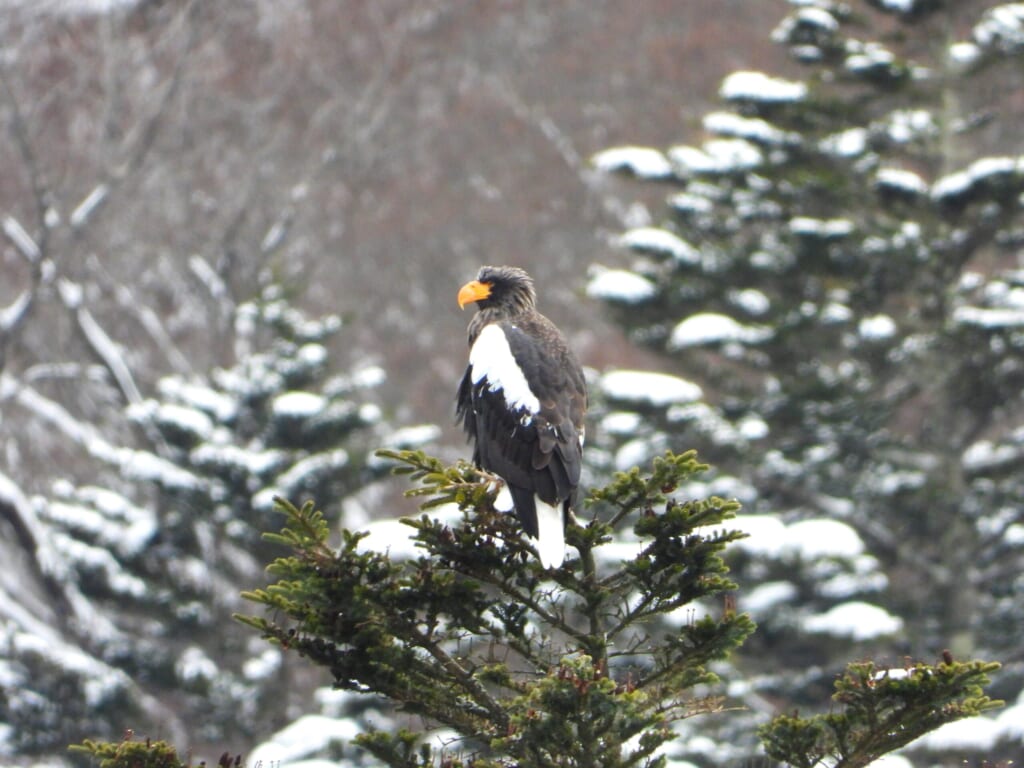
An adult Steller’s Sea Eagle has a massive yellow bill that can be obvious even at considerable distance.
The body is very dark, with striking white areas on the shoulders and tail.
The combination of:
huge yellow bill + dark body + white shoulders and tail
is very distinctive.
▶Steller’s Sea Eagle (Haliaeetus pelagicus) – Wildlife of Japan
White-tailed Eagles Are Browner
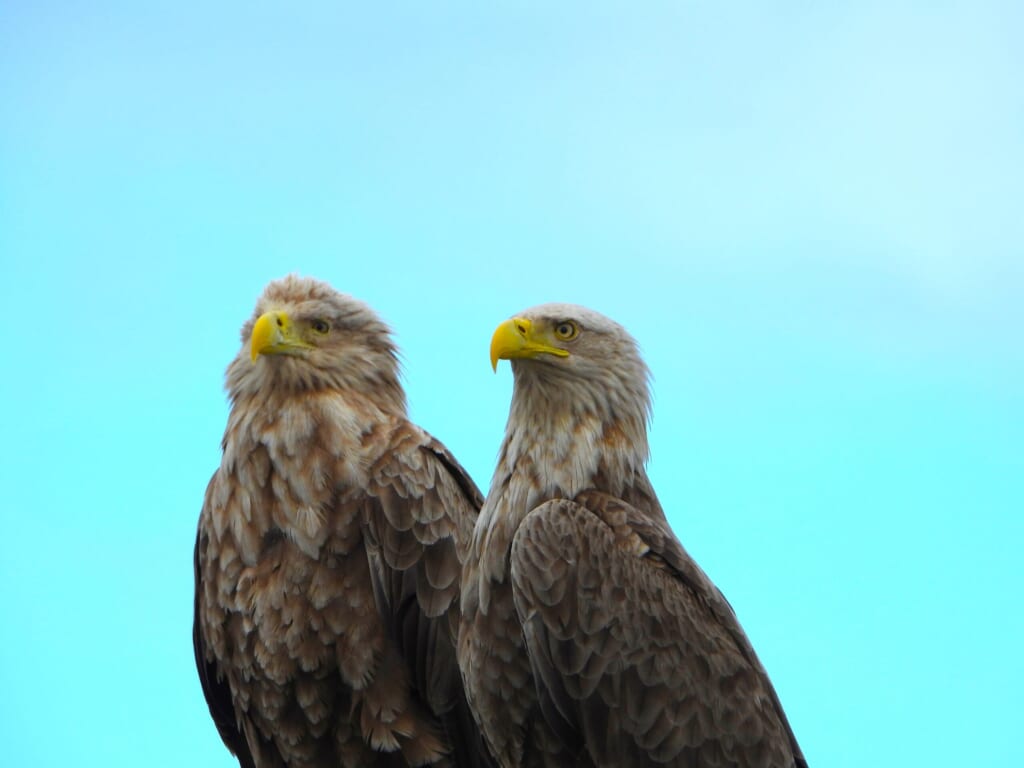
Adult White-tailed Eagles are more uniformly brown.
They also have a yellow bill, but it is much less massive than that of a Steller’s Sea Eagle.
The white tail is one of the most useful features on an adult.
In flight, the broad wings are also noticeable.
White-tailed Eagles may look less dramatic beside a Steller’s Sea Eagle, but they are still extremely large birds.
▶White-tailed Eagle (Haliaeetus albicilla) – Wildlife of Japan
A Simple Field Identification Order
When you find a large eagle in the distance, check:
bill → body color → white markings → tail
For Steller’s Sea Eagle, look for:
massive yellow bill + dark body + white shoulders and tail
For White-tailed Eagle, look for:
smaller yellow bill + brown body + white tail
Young birds are much more difficult.
Immatures of both species can look mostly brown and lack the clear adult plumage patterns.
If you are unsure, take a photo and check the details later rather than forcing an identification in the field.
Rausu and Shiretoko – Sea Eagles and Drift Ice
Rausu is the most famous place in Hokkaido for winter sea eagles.
Large numbers of Steller’s Sea Eagles and White-tailed Eagles gather in the area during winter, and when drift ice enters the Nemuro Strait, the birds may rest on the ice.
For many international birders and wildlife photographers, this is the image they associate most strongly with Hokkaido in winter.
One reason Rausu is so popular is the availability of winter cruises.
From a boat, you may have opportunities to watch sea eagles resting on the ice, flying low over the water, or moving between feeding and resting areas.
For photography, this can be very different from watching eagles from shore.
However, winter conditions are unpredictable.
Drift ice can move away, and strong winds or rough seas can affect boat operations.
If a cruise is one of the main reasons for your trip, it is better to leave some flexibility in your itinerary rather than relying on a single morning.
Nemuro and Lake Furen – Searching for Sea Eagles from Land
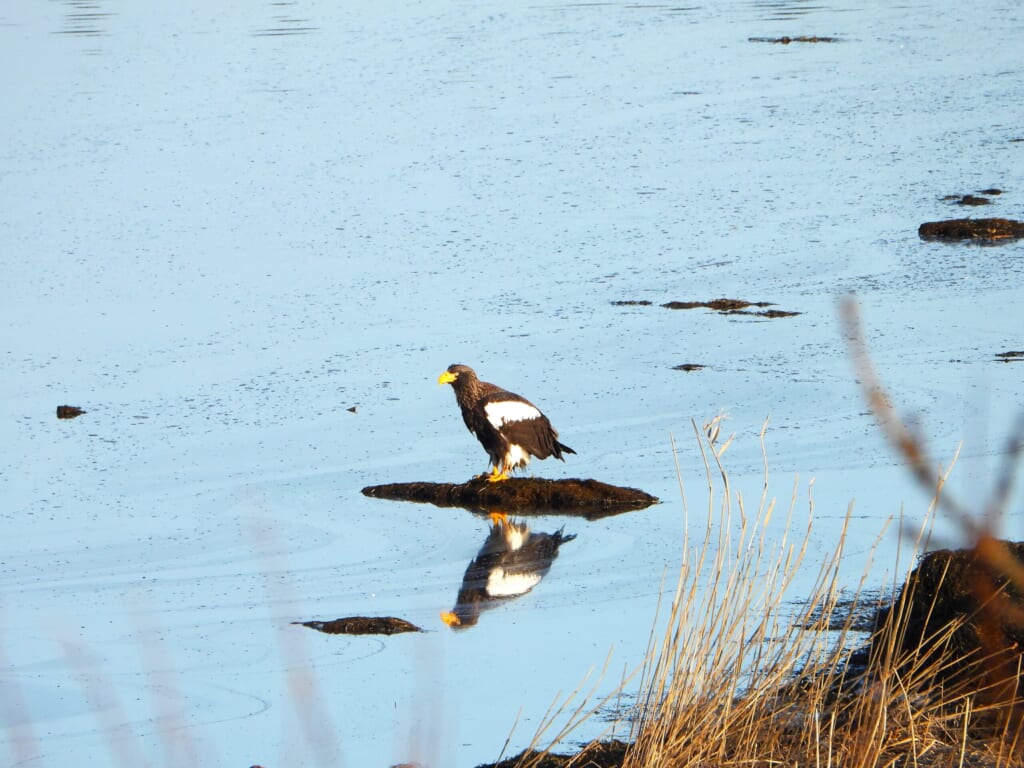
If you want to look for sea eagles without taking a boat, the Nemuro area is one of the best places to consider.
Around Nemuro, sea eagles can be found near places such as:
- Lake Furen
- Shunkunitai
- Cape Nosappu
- Nemuro Port
- Hanasaki Port
- Habomai and the surrounding coast
Lake Furen in particular is well known for wintering eagles.
The experience here is different from Rausu.
Instead of joining one dedicated cruise, you can move between lakes, coastline, harbors, and open landscapes while searching on your own.
Check large trees carefully.
But do not only look at trees or ice.
Look up as well.
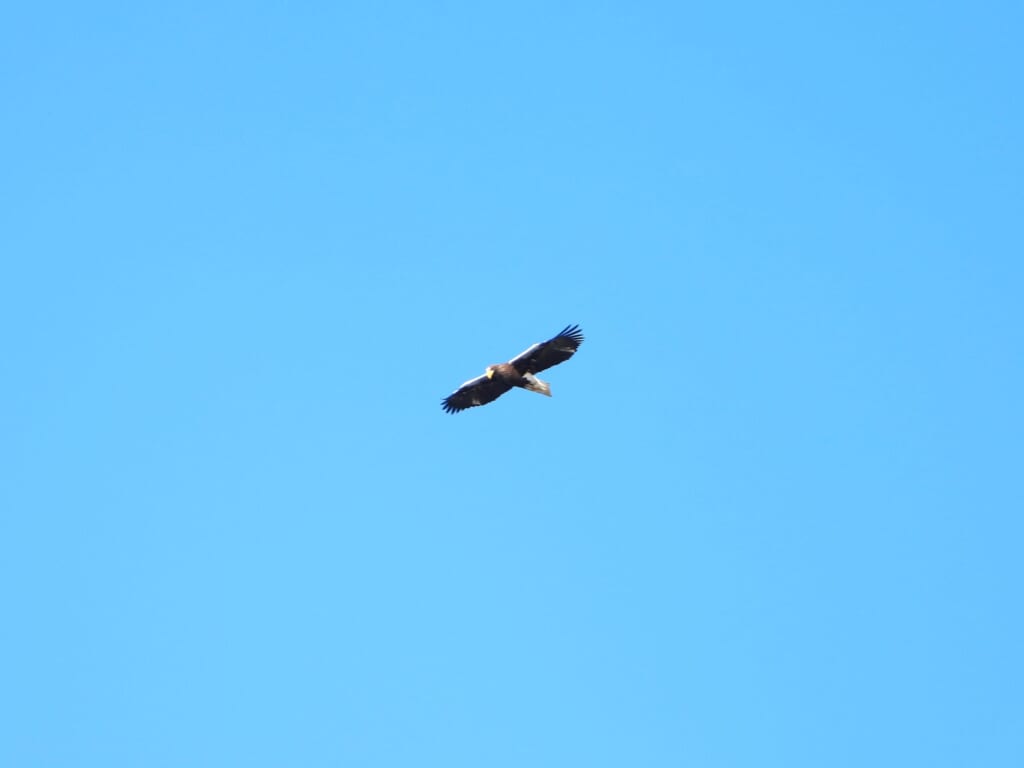
Because both species are so large, a flying eagle can be visible from surprisingly far away.
Shunkunitai and the Nemuro Peninsula – Give Each Area Time
Shunkunitai lies beside Lake Furen and is one of the better-known birding areas around Nemuro.
Both Steller’s Sea Eagles and White-tailed Eagles are recorded in the wider area.
If you are staying in Nemuro, it fits naturally into a day of birding around Lake Furen and the peninsula.
Wildlife does not stay in exactly the same place every day.
If recent sightings are available from a local nature center or birding facility, they can be useful when deciding where to spend your time.
I would also avoid arriving at one point, looking around for only a few minutes, and deciding there are no eagles.
Scan the wider landscape and give the area time.
Notsuke Peninsula – Where I Have Seen Both Species
The Notsuke Peninsula is another place I would not leave out of a Hokkaido sea eagle trip.
I have personally seen both Steller’s Sea Eagles and White-tailed Eagles there.
The peninsula has open views across the sea, bays, wetlands, and grassland, which makes large raptors easier to notice.
Notsuke is not simply a place where I happened to get lucky.
According to official Notsuke Peninsula information, roughly one-third of the Steller’s Sea Eagles and White-tailed Eagles wintering in Japan gather in this region, with more than 300 birds recorded in some years.
Rausu may be better known internationally because of its drift-ice cruises, but Notsuke is a serious sea eagle destination in its own right.
If you are traveling through eastern Hokkaido, it is well worth including.
Are Steller’s Sea Eagles and White-tailed Eagles Difficult to Find?
From my own experience, not necessarily.
They are wild birds, so nothing is guaranteed.
But if you visit established wintering areas in eastern Hokkaido and spend enough time searching, they are not birds that require extraordinary luck.
One reason is simply their size.
Both species are enormous.
If one is sitting in a distant tree, it often stands out.
If one is flying over an open landscape, it is usually easier to notice than a smaller raptor.
When I search for sea eagles, I do not arrive somewhere and immediately leave if I do not see one.
I scan:
large trees → ice → shoreline → open water → sky
On the Notsuke Peninsula, where the landscape is open, a large eagle can be especially noticeable.
So I would not approach a Hokkaido sea eagle trip with the idea that:
“These birds are too rare to find unless I get lucky.”
Choosing the right area and giving yourself time matters much more.
Do You Need a Cruise to See Sea Eagles in Hokkaido?
No.
Rausu’s drift-ice cruises are famous, so it is easy to assume that a boat is necessary.
It is not.
If your goal is simply to see Steller’s Sea Eagles and White-tailed Eagles, you can search from land around Nemuro, Lake Furen, Shunkunitai, the Notsuke Peninsula, and other parts of eastern Hokkaido.
A cruise becomes especially valuable if your goal is different:
You want to see eagles on drift ice.
You want closer views over the sea.
You want better opportunities for flight photography.
That is the key distinction.
Seeing sea eagles and seeing sea eagles on drift ice are not exactly the same experience.
If you prefer not to drive on snow and ice, or if you have limited time and want local help finding wildlife, a guided tour can also be a good option.
Winter roads in Hokkaido can be demanding, especially for travelers who are not used to snow and ice.
What It Is Like to See Both Sea Eagles in Hokkaido
I have watched and photographed both Steller’s Sea Eagles and White-tailed Eagles in Hokkaido.
Even if you already know what they look like from photos, seeing them in the field feels different.
Steller’s Sea Eagle is especially striking.
The huge yellow bill and bold dark-and-white plumage make it stand out even from a distance.
White-tailed Eagles are also enormous, but the overall impression is different.
When you see both species in the same region, the differences in bill size, body color, wing shape, and overall appearance become much easier to appreciate.
After searching for them on several trips, I also stopped thinking of sea eagles as birds you simply have to wait for by chance.
If you choose the right wintering area and spend time scanning properly, you can actively look for them.
That was also my experience on the Notsuke Peninsula, where I was able to see both species.
For me, that is part of what makes sea eagle watching in Hokkaido so enjoyable.
You are not only visiting one famous observation point.
You are scanning the coast, frozen lakes, bays, open sky, and distant trees for some of the largest raptors you can encounter in Japan.
Watching Sea Eagles Responsibly

Both Steller’s Sea Eagles and White-tailed Eagles are protected species in Japan.
Because they are so large, you usually do not need to approach closely to enjoy watching them.
Use binoculars or a telephoto lens and give resting birds space.
Do not keep moving closer until an eagle takes flight.
White-tailed Eagles also breed in Hokkaido, so extra care is needed around nesting areas.
If you find a nest or breeding birds, keep your distance.
Roadside wildlife watching also requires common sense.
Avoid:
- sudden stops on busy roads
- parking in unsafe places
- standing in traffic to take photos
- entering private land
- feeding wildlife
- approaching until a bird is forced to fly
The goal should be to watch the eagle behaving naturally, not to get as close as possible.
Final Thoughts
If you want to see Steller’s Sea Eagles and White-tailed Eagles in Hokkaido, start with eastern Hokkaido.
For drift ice and sea eagles: Rausu.
For land-based searching: Nemuro and Lake Furen.
For another major wintering area: Notsuke Peninsula.
January and February are the strongest months for seeing both species, while February is especially attractive if drift ice is part of your goal.
And despite their rarity and impressive size, these are not necessarily impossible birds to find.
Visit the right places, give yourself time, and scan widely.
Look at the shoreline, frozen lakes, open water, large trees, and sky.
If you find a Steller’s Sea Eagle, look around for a White-tailed Eagle too.
Seeing both species in the same Hokkaido landscape makes their differences much more obvious—and much more impressive—than any field guide can.
▶Steller’s Sea Eagle (Haliaeetus pelagicus) – Wildlife of Japan
▶White-tailed Eagle (Haliaeetus albicilla) – Wildlife of Japan