Beetles in Japan: Species, Season & Where to Find Them
Japan is home to many fascinating beetles, including Japanese rhinoceros beetles, stag beetles, longhorn beetles, and colorful flower beetles.
The best time to see many of them is during the warm summer months. Rhinoceros beetles and stag beetles often gather around tree sap or fly toward lights at night, while other species can be found on flowers, under fallen wood, or along forest trails.
The beetles you encounter will vary depending on the season, region, elevation, and habitat. This guide covers some of the most common and distinctive beetles found in Japan, as well as when and where you are most likely to see them.
Common Types of Beetles in Japan
The best-known beetles in Japan are the Japanese rhinoceros beetle, called kabutomushi, and stag beetles, known as kuwagata. Both are strongly associated with summer and are popular among children and insect enthusiasts.
However, Japan is home to many other kinds of beetles, including:
- Rhinoceros and stag beetles, which are often found around tree sap or lights at night
- Longhorn beetles, known for their unusually long antennae
- Flower beetles and chafers, which visit flowers, fruit, and tree sap
- Ground, dung, carrion, and aquatic beetles, which live in forests, fields, ponds, and streams
Some are large and easy to recognize, while others are small and often overlooked. The following sections introduce several beetles you may encounter in Japan.
Japanese Rhinoceros Beetle (Trypoxylus dichotomus)
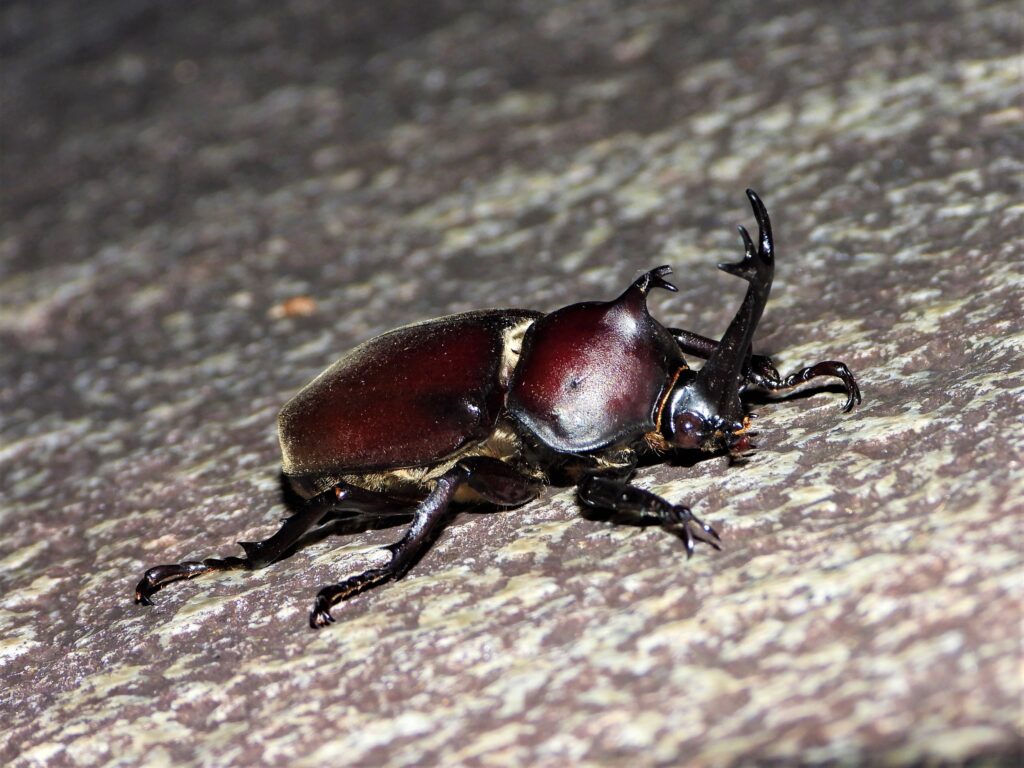
The Japanese rhinoceros beetle, known as kabutomushi in Japan, is one of the country’s best-known summer insects. Males are easy to recognize by the large, forked horn on the head, while females have no prominent horn.
Adults are mainly seen from June to August in deciduous woodland, wooded parks, and rural areas. They feed on tree sap and may also fly toward outdoor lights at night.
The best chance of finding one is to check sap-producing trees after sunset or look around lights near wooded areas.
▶ Read the full Japanese Rhinoceros Beetle guide
Common Stag Beetles in Japan
Japan is home to several well-known stag beetles. Some are common in parks and lowland forests, while others are more closely associated with cool mountain forests or warmer parts of the country.
The species below are among the stag beetles you are most likely to recognize or encounter in Japan.
Little Stag Beetle (Dorcus rectus)
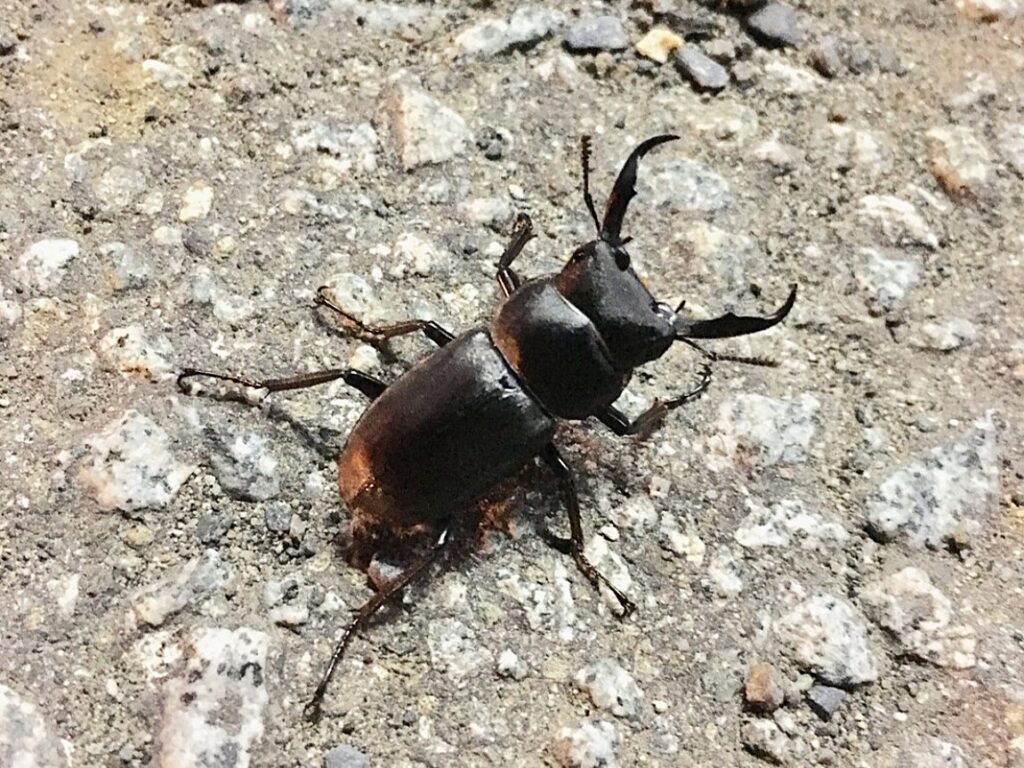
Known as kokuwagata in Japan, the little stag beetle is one of the country’s most commonly encountered stag beetles. It has a glossy black to dark brown body and relatively small mandibles, although larger males can look surprisingly impressive.
It can be found from late spring to early autumn in deciduous forests, wooded parks, and other areas with mature trees. At night, it often gathers around tree sap, while during the day it may hide under bark or inside tree crevices.
In my own observations, this is the stag beetle I find most often when checking sap trees at night.
▶ Read the full Little Stag Beetle guide
Japanese Saw Stag Beetle (Prosopocoilus inclinatus)
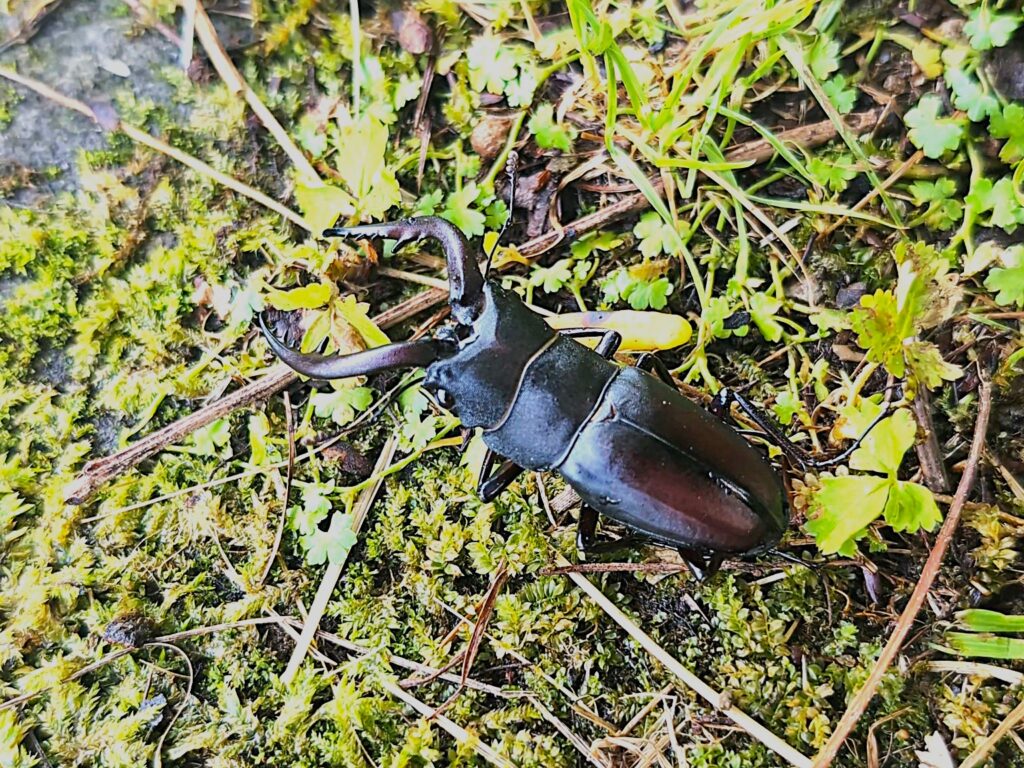
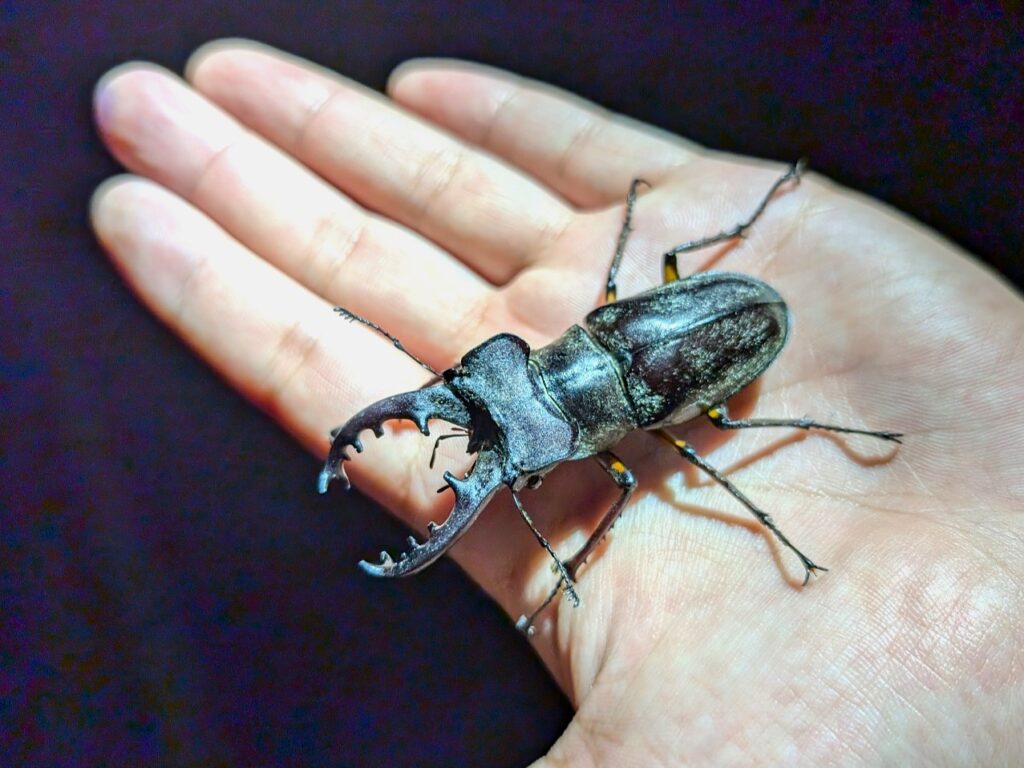
The Japanese saw stag beetle is one of the most familiar stag beetles in Japan. Large males have long, curved mandibles lined with small teeth, while smaller males have shorter and straighter jaws.
It is widely distributed across Japan and is often found in woodlands, satoyama landscapes, and areas with mature trees. Adults gather around tree sap on summer nights and may also fly toward outdoor lights.
I have found this species beneath a light at night, making illuminated areas near woodland another place worth checking.
▶ Read the full Japanese Saw Stag Beetle guide
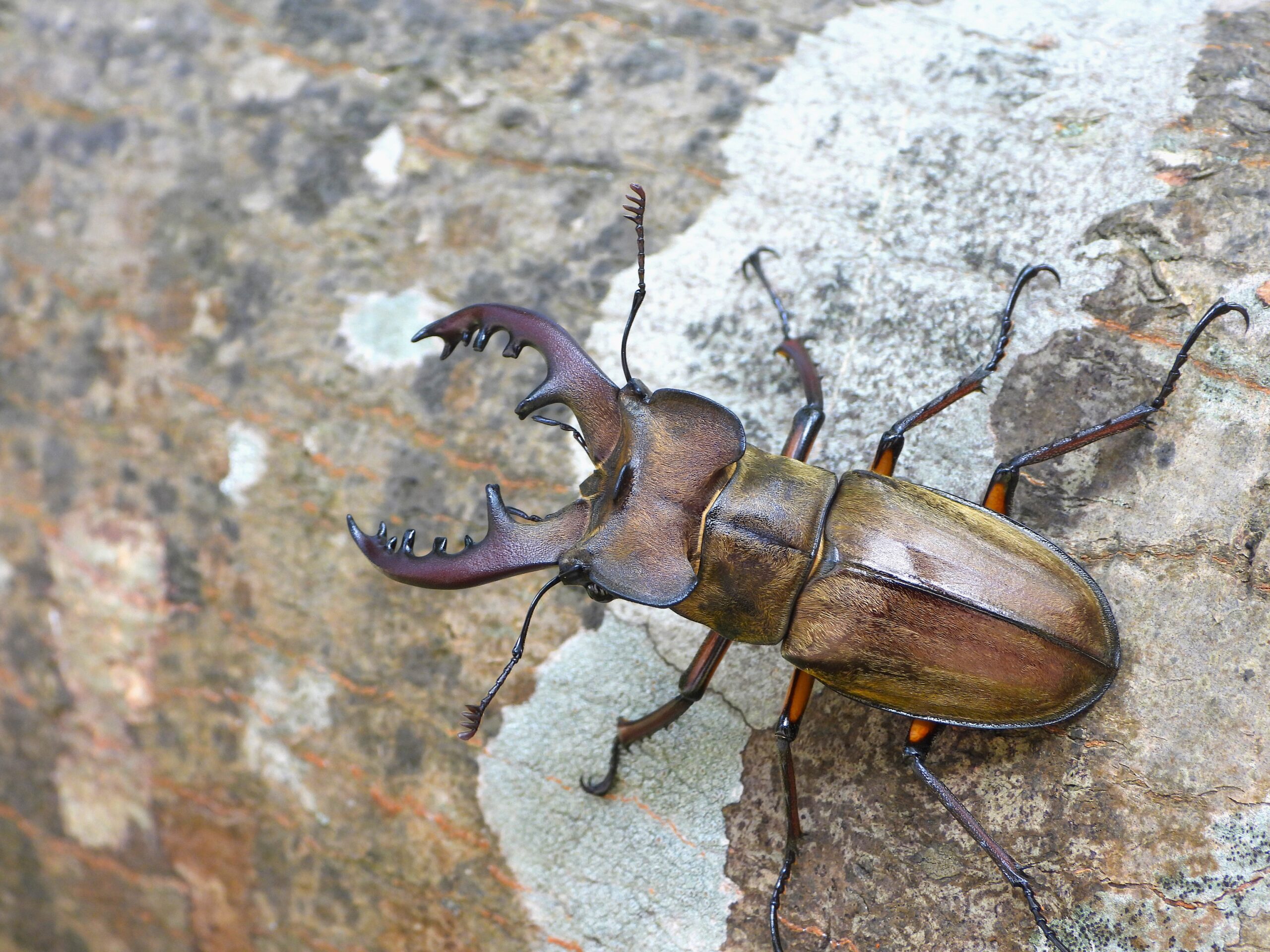
Miyama Stag Beetle (Lucanus maculifemoratus)
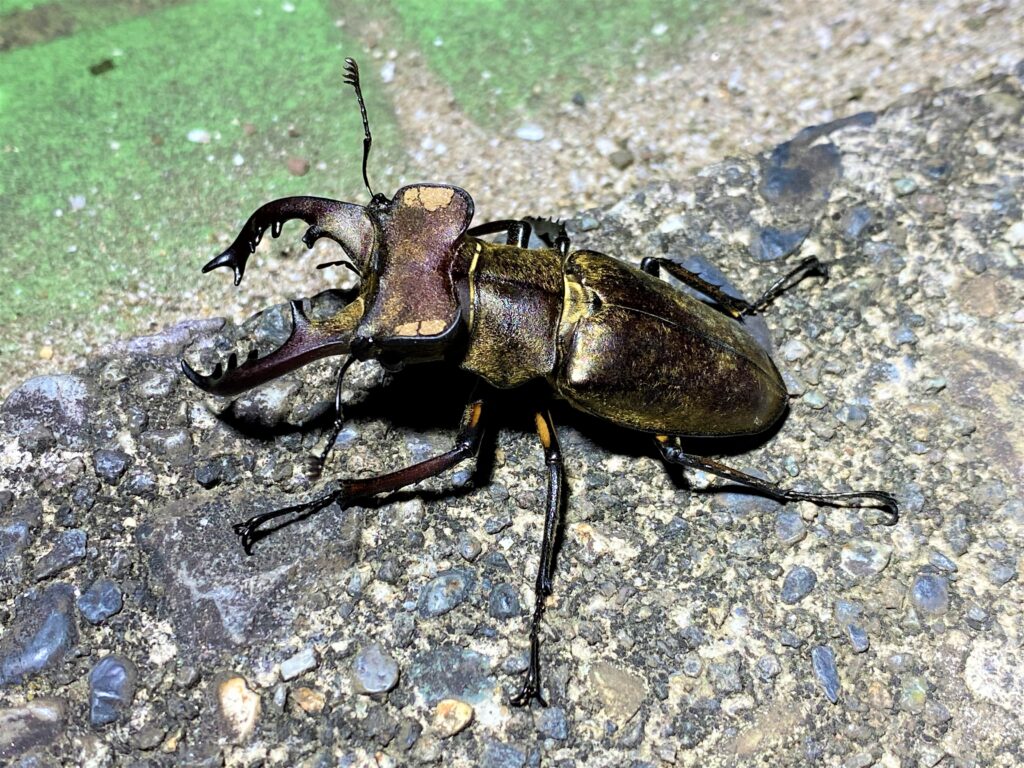
The Miyama stag beetle is one of Japan’s most distinctive stag beetles. Large males have long, antler-like mandibles, small projections on the sides of the head, and fine golden hairs that give the body a slightly velvety appearance.
It prefers cooler woodland and mountain forests and is found from Hokkaido to Kyushu. Adults are mainly seen in summer, often around tree sap or lights near forested areas.
The male pictured at the top of this guide was one I encountered and photographed in Japan.
▶ Read the full Miyama Stag Beetle guide
Japanese Giant Stag Beetle (Dorcus hopei)
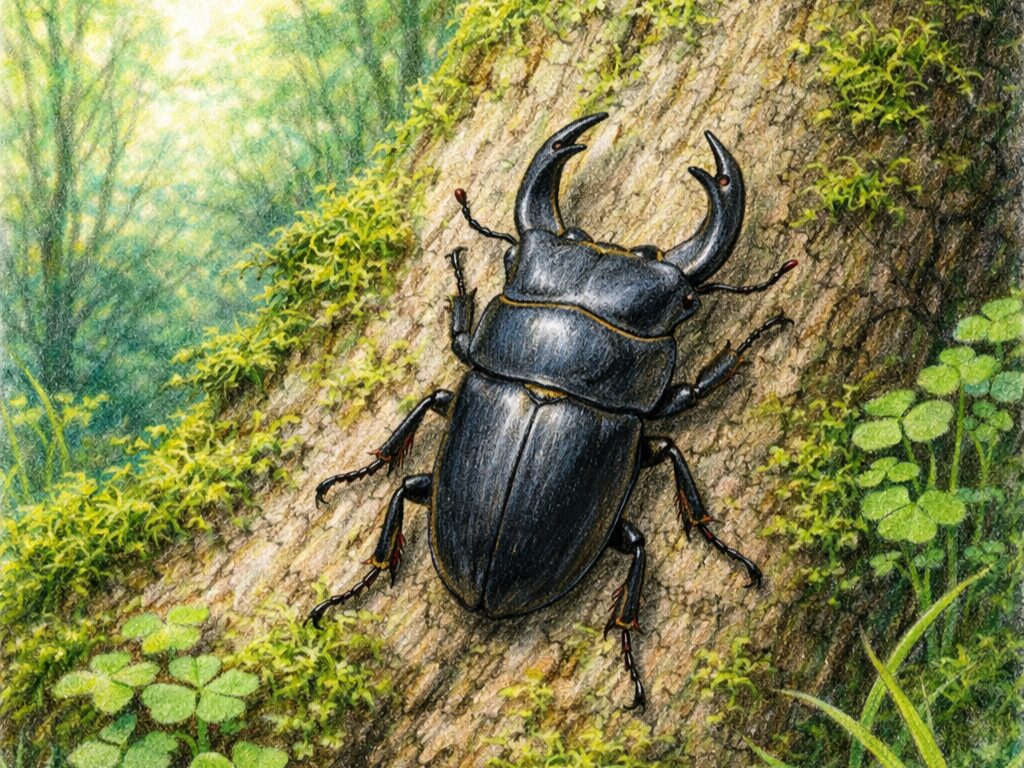
Known as ookuwagata in Japan, the Japanese giant stag beetle is one of the country’s largest stag beetles. Large males have a broad, glossy black body and thick mandibles with prominent teeth on the inner edge.
Wild individuals are much harder to find than little or saw stag beetles. They are associated with mature deciduous forests and old trees with hollows, where they often remain hidden during the day and emerge to feed on tree sap at night.
The Japanese subspecies is listed as Vulnerable on Japan’s national Red List. If you encounter one in the wild, avoid damaging the tree or disturbing its hiding place.
Japanese Flat Stag Beetle (Dorcus titanus)
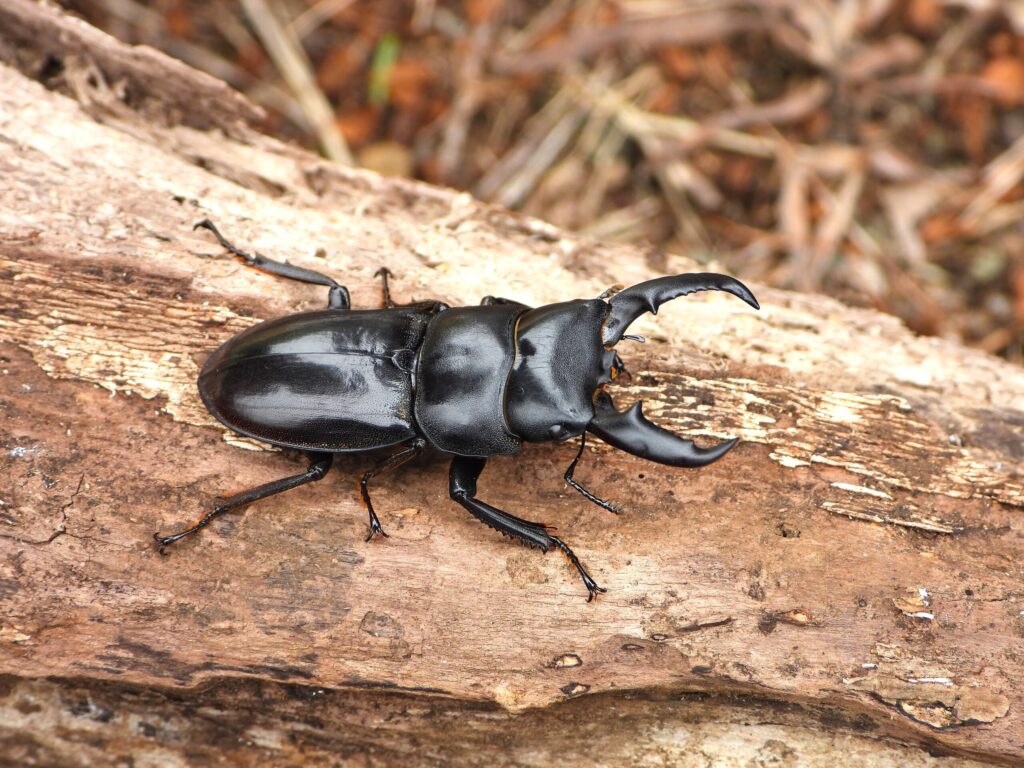
The Japanese flat stag beetle has a broad, flattened body and a glossy black appearance. Large males have thick, powerful mandibles and look heavier than many other stag beetles found in Japan.
It is mainly found in the warmer parts of the country, including Honshu, Shikoku, Kyushu, and the southern islands. During the day, it often hides under bark or inside tree crevices. After dark, it becomes active and visits tree sap.
Its size and appearance vary between regions, particularly among isolated island populations. Some southern populations grow especially large and have noticeably different mandible shapes.
▶ Read the full Japanese Flat Stag Beetle guide
Other Beetles Found in Japan
Rhinoceros beetles and stag beetles may be the most famous, but Japan is also home to many other distinctive beetles.
Longhorn beetles can be found on trees and fallen wood, flower chafers visit flowers and tree sap, and ground beetles move across the forest floor. Dung beetles, carrion beetles, and aquatic beetles occupy very different habitats.
Here are a few notable examples that you may encounter in Japan.
Japanese Ground Beetle (Damaster blaptoides)

Known as maimai-kaburi in Japan, this large ground beetle is found only in Japan. It has a long, narrow head and strong mandibles adapted for feeding on land snails.
Unlike rhinoceros and stag beetles, it cannot fly. It usually walks across the forest floor at night and hides beneath fallen wood, stones, or leaf litter during the day.
Its color and body shape vary between regions, with some populations appearing almost black and others showing metallic blue or green tones.
▶ Read the full Japanese Ground Beetle guide
White-striped Longhorn Beetle (Batocera lineolata)
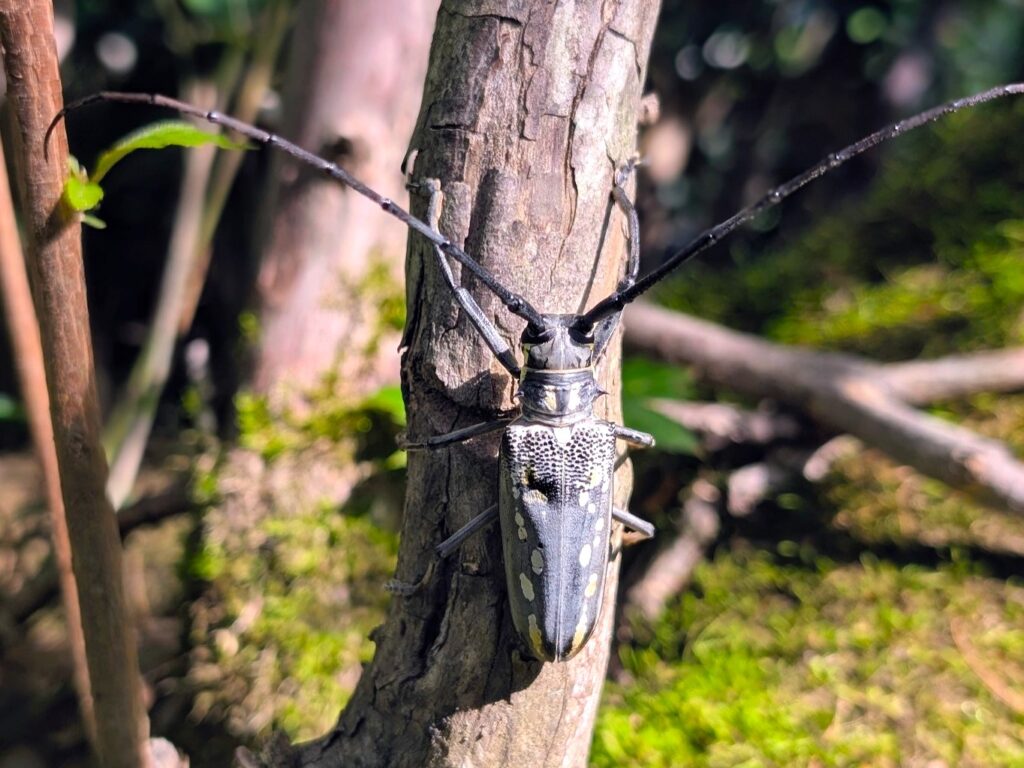
The white-striped longhorn beetle is one of the largest longhorn beetles found in Japan. It has a grayish-black body with pale stripes and exceptionally long antennae.
Adults are mainly seen from June to August in forests, wooded parks, and other areas with mature trees. They are active mostly at night and may appear around outdoor lights near woodland.
I once found a large individual clinging to a park tree on a warm summer evening. Its size and long antennae made it easy to notice, even in the dark.
▶ Read the full White-striped Longhorn Beetle guide
Flower Chafers and Other Scarab Beetles
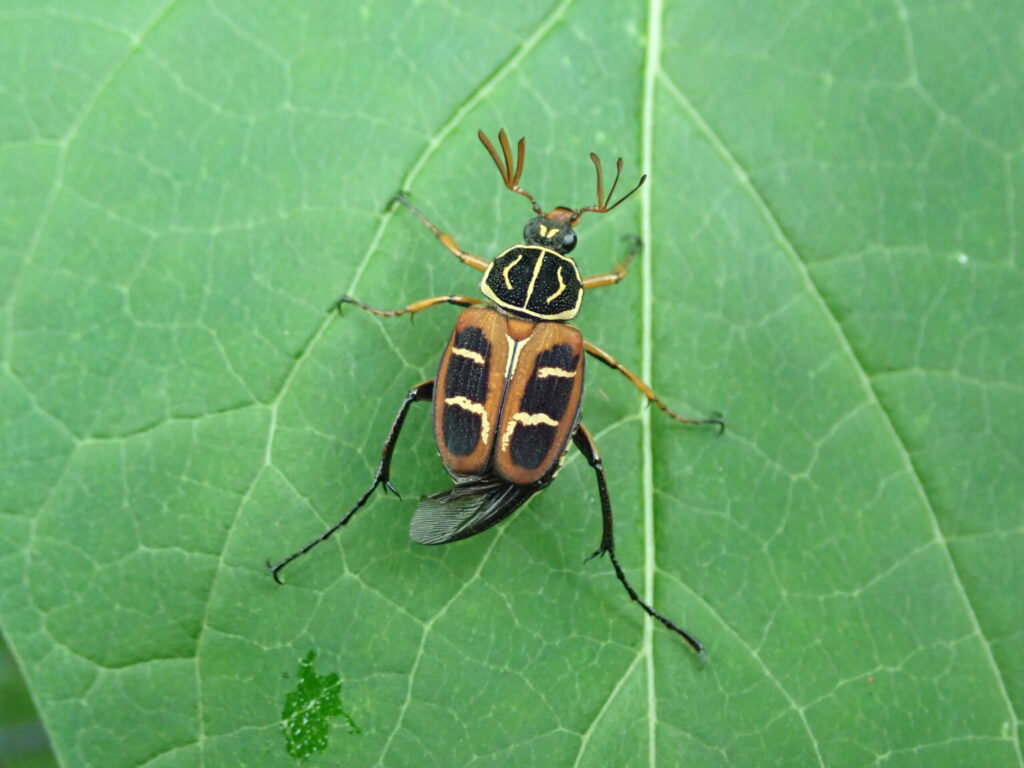
Not all scarab beetles in Japan are large or horned. Many flower chafers are smaller, colorful beetles that are active during the day and visit flowers, fruit, or tree sap.
One striking example is the Ootorafu Hanamuguri (Paratrichius doenitzi), a flower chafer native to Japan. Males have bold yellow-and-black markings, while females are darker and less brightly patterned. Adults are mainly seen from early summer through midsummer around flowers along forest edges and mountain trails.
Japan is also home to metallic scarab beetles such as the Kin-suji Kogane (Mimela holosericea), which may appear near lights in mountain areas on summer nights.
▶ Read the Ootorafu Hanamuguri guide
▶ Read the Kin-suji Kogane guide
Dung and Carrion Beetles
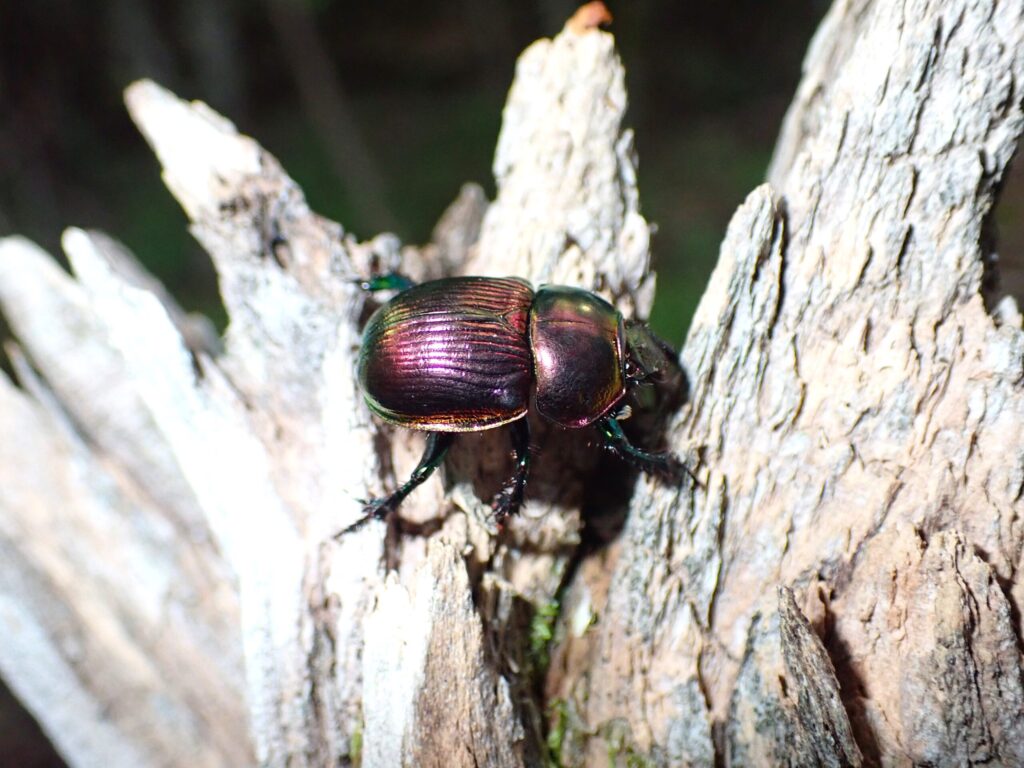
Dung beetles and carrion beetles are easy to overlook, but they play an important role in Japan’s forests by breaking down animal waste and remains.
The Japanese earth-boring dung beetle (Phelotrupes auratus) is especially striking, with a metallic body that may appear green, blue, red, or purple. It digs into the soil near animal droppings and carries pieces underground.
Carrion beetles such as the Oo-hirata-shidemushi (Eusilpha japonica) have flatter, darker bodies. They are often found walking on the forest floor or along woodland roads while searching for small animal remains and other decaying material.
▶ Read the Japanese Earth-boring Dung Beetle guide
▶ Read the Oo-hirata-shidemushi guide
Aquatic Beetles
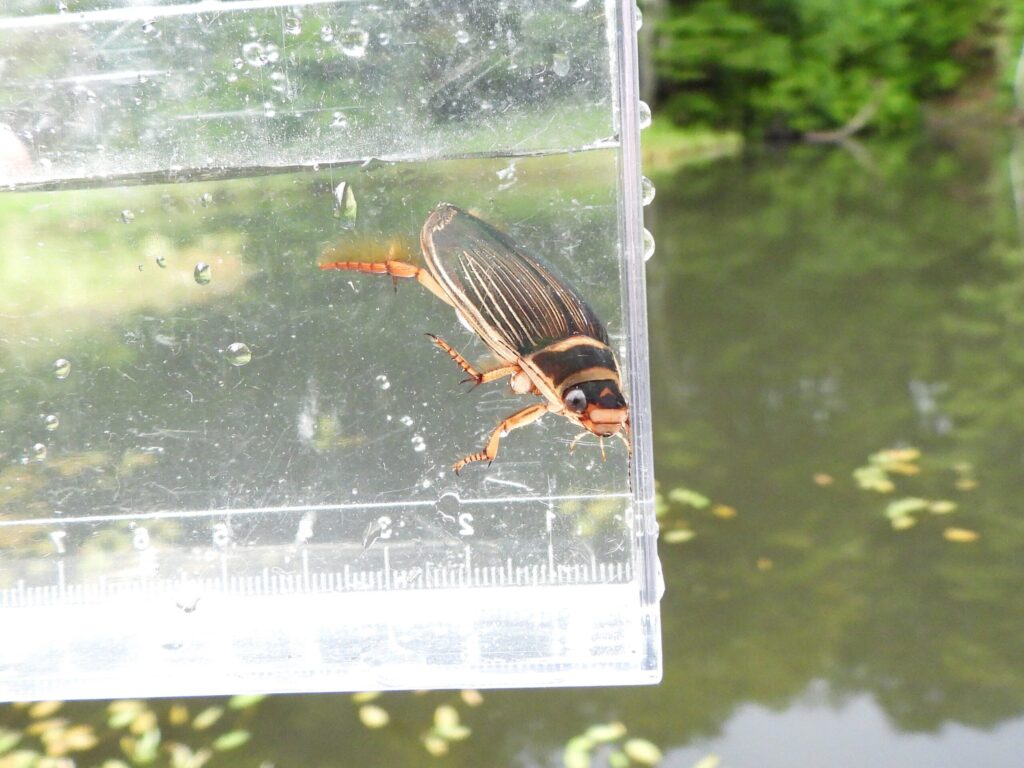
Japan’s ponds, marshes, rice fields, and slow-moving streams are also home to aquatic beetles.
Diving beetles have smooth, streamlined bodies and powerful hind legs that work like paddles. Both adults and larvae are predators that feed on other small animals in the water.
The beetle pictured here is an Ezo gengorou-modoki that I encountered and photographed in Japan. Species like this are easy to overlook because they spend most of their lives beneath the water’s surface.
Aquatic beetles are less noticeable than beetles found on trees or around lights, but they are an important part of Japan’s freshwater wildlife.
When is beetle season in Japan?
Beetles can be found in Japan from spring through autumn, but the best season depends on the species. For visitors hoping to see rhinoceros beetles and stag beetles, summer offers the best chance.
- May to June: Some stag beetles, longhorn beetles, and flower beetles begin to appear.
- July to August: This is the main season for Japanese rhinoceros beetles, many stag beetles, flower chafers, and longhorn beetles.
- September and later: Rhinoceros beetles become much less common, but some stag beetles, longhorn beetles, ground beetles, and other species may still be active.
The exact timing varies by species, region, elevation, and weather. Beetles may appear later in northern Japan and cool mountain areas, while the seasonal pattern can be different in the warmer southern islands.
Where to Find Beetles in Japan
Beetles live in many different habitats across Japan. Forests offer the greatest variety, but some species can also be found in parks, farmland, ponds, and even around outdoor lights near residential areas.
The best place to look depends on the type of beetle you want to find.
Tree Sap
Japanese rhinoceros beetles and many stag beetles gather around sap flowing from broadleaf trees, especially during warm summer nights.
Check mature trees in wooded parks, satoyama landscapes, and forest edges. Look carefully without peeling bark or damaging the tree, as beetles may be hiding inside nearby cracks.
Lights Near Wooded Areas
Many beetles are attracted to outdoor lights at night. Streetlights, vending machines, rest areas, and illuminated buildings near forests can attract stag beetles, rhinoceros beetles, longhorn beetles, and scarab beetles.
I have found several beetles beneath lights near woodland, including a male Japanese saw stag beetle.
Flowers and Forest Edges
Flower chafers, scarab beetles, and some longhorn beetles are active during the day. They may be found visiting flowers along woodland paths, in grasslands, gardens, and along forest edges.
Sunny areas with many flowering plants are especially worth checking from late spring through summer.
Fallen Wood and the Forest Floor
Ground beetles, carrion beetles, and other less noticeable species live beneath fallen wood, stones, bark, and leaf litter.
Avoid pulling apart decaying logs or disturbing large areas of the forest floor. Beetles can often be observed simply by walking slowly along forest roads and trails, especially after dark.
Ponds, Rice Fields, and Streams
Aquatic beetles live in ponds, marshes, rice fields, and slow-moving streams. They are usually harder to observe because they spend most of their time underwater.
Look into clear, shallow water from the edge rather than entering the habitat or disturbing aquatic plants.
Best Time of Day to Look for Beetles in Japan
For Japanese rhinoceros beetles and many stag beetles, the best time to search is usually from shortly after sunset until late evening. They become more active at night and may gather around tree sap or fly toward lights near wooded areas.
Early morning can also be a good time to look. Beetles that arrived during the night may still be resting on sap trees, walls, or the ground beneath outdoor lights.
Not all beetles are nocturnal. Flower chafers and some longhorn beetles are easier to find during the day, especially on flowers and along sunny forest edges.
Tips for Finding Beetles
- Bring a flashlight and check both tree trunks and the ground.
- Walk slowly around lights near forests, parks, and mountain roads.
- Look closely at cracks in tree bark, but do not peel the bark away.
- Avoid damaging trees, fallen wood, or other beetle habitats.
- Watch where you step, as beetles may be resting on roads and paths.
Warm summer evenings are usually the easiest time to find rhinoceros and stag beetles. Heavy rain and strong winds can make searching more difficult.
FAQ
What Is the Largest Beetle in Japan?
There is no single simple answer because beetle size can be measured by body length, horns, or mandibles. Large male Miyama and Japanese saw stag beetles can reach around 7–8 cm when their mandibles are included.
Japanese rhinoceros beetles and Japanese giant stag beetles are also among the largest and most recognizable beetles found in Japan.
Can You Find Beetles in Japanese Cities?
Yes. Beetles can be found in large parks, wooded temple or shrine grounds, suburban forests, and other green spaces within or near Japanese cities.
Little stag beetles and flower chafers are among the species that may appear in urban areas. Rhinoceros beetles and larger stag beetles are more likely where mature trees and suitable woodland remain.
Is It Better to Look for Beetles During the Day or at Night?
Night is usually best for Japanese rhinoceros beetles and stag beetles. They become active after sunset and may gather around tree sap or fly toward outdoor lights.
During the day, flower chafers and some longhorn beetles can be found on flowers, leaves, or tree trunks. The best time therefore depends on the type of beetle you want to see.
What Is the Best Month to See Beetles in Japan?
July is generally the best month for seeing Japanese rhinoceros beetles and many stag beetles. They can also be found during June and August, although the exact timing varies by species, region, elevation, and weather.
Some other beetles begin appearing in spring or remain active into early autumn.
Are Beetles in Japan Dangerous?
Most beetles in Japan are not dangerous to people. Large stag beetles can pinch with their mandibles, and rhinoceros beetles have strong claws that may scratch the skin.
Avoid gripping or disturbing wild beetles. Observing or photographing them without handling them is usually the safest option.
Explore More Beetles in Japan
Japan is home to far more than rhinoceros beetles and stag beetles. Explore the guides below for more detailed information about the identification, habitats, seasons, and behavior of beetles found in Japan.
▶ Japanese Rhinoceros Beetle
Learn how to identify Japan’s famous kabutomushi and where to find it during summer.
▶ Japanese Saw Stag Beetle
Discover the distinctive mandibles, habitat, season, and behavior of the Japanese saw stag beetle.
▶ Miyama Stag Beetle
Learn where the Miyama stag beetle lives and how to recognize this mountain-dwelling species.
▶ Japanese Ground Beetle
Meet the flightless maimai-kaburi, a beetle found only in Japan and adapted to hunting land snails.
▶ White-striped Longhorn Beetle
Discover one of Japan’s largest longhorn beetles and the habitats and seasons in which it can be found.
▶ Japanese Earth-boring Dung Beetle
Learn about the metallic colors and ecological role of this striking forest dung beetle.
▶ Insects in Japan: Common, Seasonal & Dangerous Species Guide
Explore butterflies, moths, dragonflies, mantises, hornets, and other insect groups found across Japan.
▶ Animals in Japan: Native, Endemic & Iconic Species
Explore the broader guide to animals in Japan, including mammals, birds, reptiles, amphibians, insects, and marine life.