Japanese Luna Moth (Actias aliena) – Wildlife of Japan
Introduction
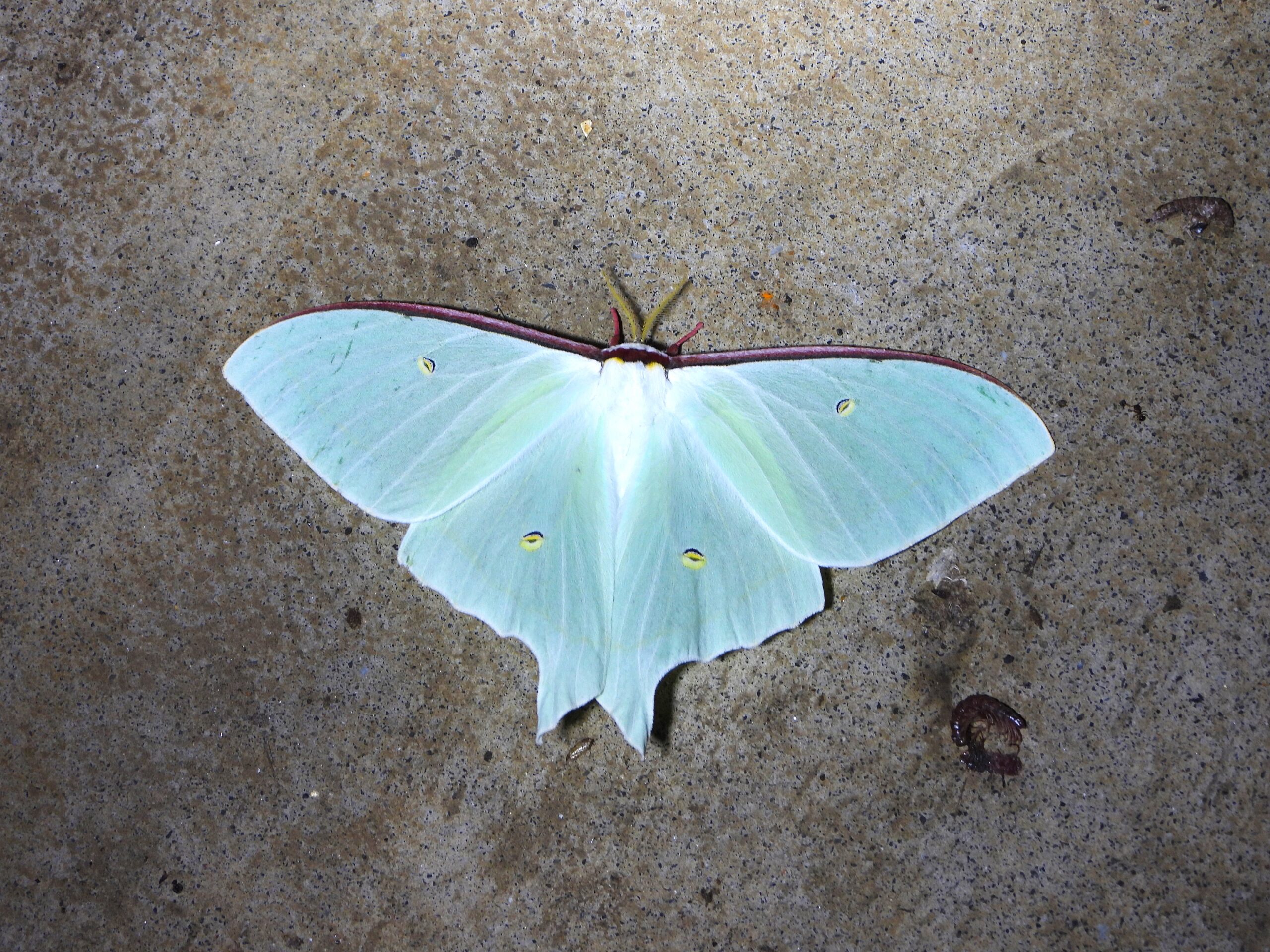
The Japanese Luna Moth (Actias aliena) is a large, pale-green saturniid moth found in Japan. It is easily recognized by its soft green wings, prominent eyespots, and long tails extending from the hindwings.
Its taxonomic treatment varies among sources. Some references list it as Actias artemis aliena, while others recognize Actias aliena as a distinct species. This guide follows Actias aliena.
Adults are mainly seen during the warmer months and may occasionally appear around lights near forests and other wooded areas.
Appearance
The Japanese Luna Moth is unmistakable for its graceful shape and soft green coloration.
- Wingspan: 80–120 mm.
- Coloration: Translucent bluish-green with a faint yellow or pinkish margin along the forewings.
- Hindwing tails: Long, ribbon-like extensions characteristic of the genus Actias.
- Antennae: Males have large, comb-like antennae for detecting female pheromones.
- Sexual dimorphism: Females are larger and heavier-bodied than males.
- Larvae: Bright green, reaching around 70–80 mm before pupation.
Japanese Luna Moth vs. Japanese Moon Moth
The names Japanese Luna Moth and Japanese Moon Moth can be confusing because they are used for very similar moths in the genus Actias.
In this guide, Japanese Luna Moth refers to Actias aliena, while Japanese Moon Moth refers to the closely related Actias gnoma.
The two species can be difficult to separate from photographs alone. Actias aliena is generally larger, and its forewing outer line is often more wavy, while the same line tends to be straighter in Actias gnoma. The hindwing marking also tends to be more elongated in A. aliena and rounder in A. gnoma.
These features vary between individuals, so identification should be based on several characteristics rather than a single feature.
▶ Japanese Moon Moth (Actias gnoma) – Photos & Identification
Habitat & Distribution
This species inhabits deciduous forests and forest edges, where host trees are abundant.
- Range in Japan: Honshu, Shikoku, Kyushu, and several surrounding islands.
- Altitude: Found from lowlands to mountain forests.
Where to See in Japan
Adults are most often seen from late April through May and again from July through August, although timing varies by region, elevation, and weather.
The moth is nocturnal and may visit artificial lights near forests, providing opportunities for observation after dark.
Behavior
- Activity: Nocturnal; males actively search for females during calm evenings.
- Flight period: One or two generations per year, depending on climate — single-brooded in cooler areas, double-brooded in warmer regions.
- Adult lifespan: Very short (several days to a week). Adults do not feed, surviving solely on energy stored during the larval stage.
- Light attraction: Occasionally drawn to lights, a behavior shared among many Saturniidae moths.
Diet
- Larvae: Feed on a variety of broadleaf trees, including plants in the rose, beech and oak, birch, and dogwood families.
- Adults: Non-feeding; mouthparts are reduced and non-functional.
Reproduction
After emergence, males locate females by following airborne pheromones.
Mating occurs soon after, and females lay eggs on host leaves.
The pupa overwinters within a silken cocoon attached to leaves or branches.
(Confirmed overwintering stage: pupa – NBRP data)
Conservation
The Japanese Luna Moth is not listed as threatened in Japan.
However, localized declines could result from forest loss, artificial lighting, and reduced diversity of broadleaf trees.
Further ecological monitoring would help clarify population trends.
Author’s Impression
I often see these moths gathering around streetlights in forests or parks. Their beauty always stops me in my tracks, and I can’t help but watch them closely. Among all Japanese moths, this one feels the most mysterious.