
Butterflies in Japan: Species, Seasons & Where to See Them
Japan has an impressive variety of butterflies, from familiar swallowtails in city parks to spring specialists, mountain species, and large tropical butterflies on the southern islands.
Because the country stretches from cool Hokkaido to the subtropical Ryukyu Islands, the butterflies you see can change dramatically from one region to another.
They also change with the seasons.
This guide covers the butterflies of Japan, some notable species to look for, when and where to find them, and a few things I have learned from looking for butterflies in the field.
What Butterflies Live in Japan?
More than 300 butterfly species have been recorded in Japan, including occasional migrants and vagrants.
The exact number varies depending on taxonomy and whether species that only appear temporarily are included.
Japan’s geography is one reason its butterfly life is so varied.
Hokkaido has species adapted to cooler conditions. Across Honshu, butterflies can be found in satoyama countryside, deciduous forests, mountain valleys, grasslands, and highlands.
Travel farther south to Amami, Okinawa, and the Yaeyama Islands, and the butterfly community changes again, with subtropical species that are rarely seen on the main islands.
Butterflies can turn up in many different habitats, including:
- urban parks and gardens
- satoyama and woodland edges
- deciduous forests
- mountain roads and stream valleys
- highlands and grasslands
- subtropical forests
That variety is one of the best things about looking for butterflies in Japan.
Change the season or the location, and you may find an entirely different set of species.
Notable Butterflies You Can See in Japan
The butterflies below are species I have photographed in Japan. Together, they give a good idea of just how varied the country’s butterflies can be.
Asian Swallowtail
Papilio xuthus
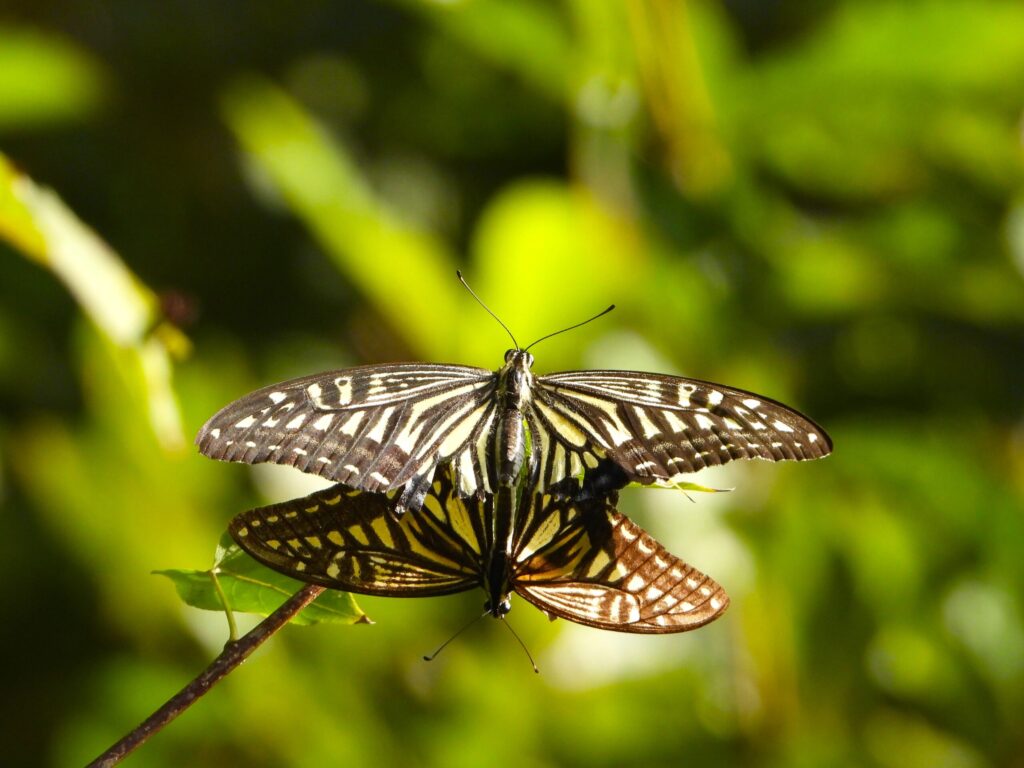
The Asian Swallowtail is one of the most familiar butterflies in Japan.
It occurs from Hokkaido to the southern islands and is not limited to wild places. You can also see it around parks, gardens, farmland, and residential areas.
Its caterpillars feed on plants in the citrus family, including citrus trees and Japanese pepper, so this is one butterfly that often lives surprisingly close to people.
Maack’s Swallowtail
Papilio maackii

Maack’s Swallowtail is one of Japan’s most beautiful butterflies, with dark wings that shine blue-green in the right light.
It is especially associated with forests and mountain areas.
I often find them along mountain roads and around stream valleys, and one of the best places to look is wet ground.
Males sometimes gather around puddles or damp soil to take in moisture and minerals. I have seen several together in the same spot.
So if you are looking for Maack’s Swallowtails, do not check only the flowers. Look at the ground as well.
Japanese Luehdorfia
Luehdorfia japonica

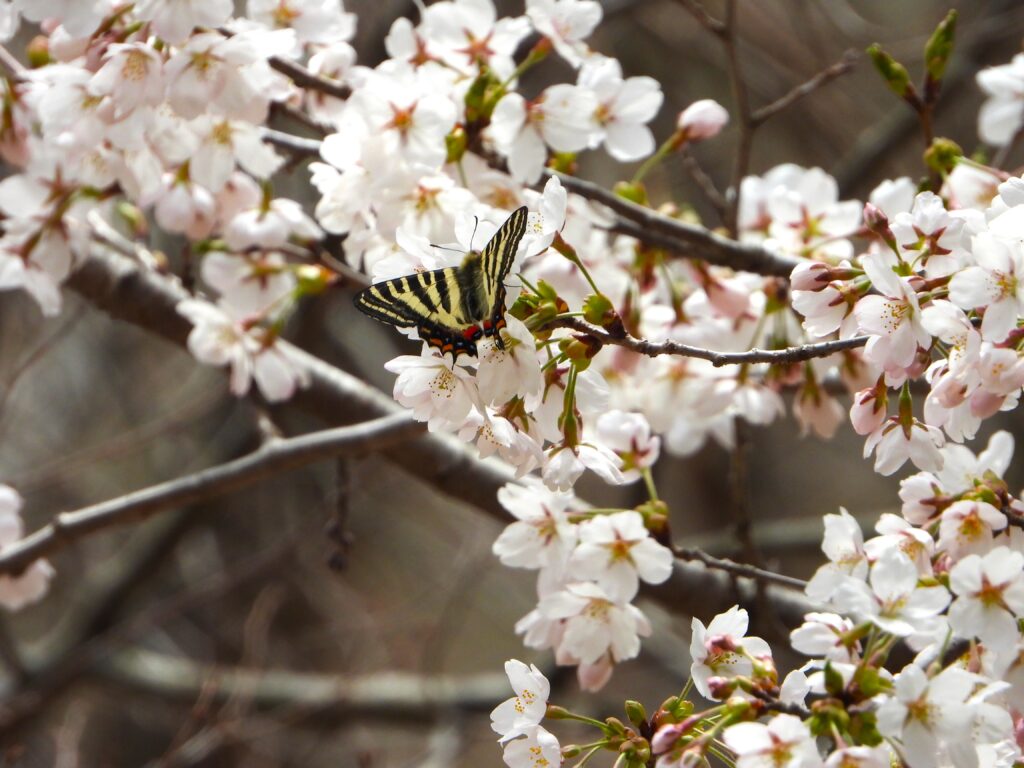
The Japanese Luehdorfia is one of Japan’s best-known spring butterflies.
It is endemic to Honshu, and adults appear for only a short period each year.
In warmer areas they may emerge from late March into April. Farther north or at higher elevations, the season can extend from late April into May.
Adults emerge only once a year, and the species spends most of its life cycle as a pupa before appearing again the following spring.
It is listed as Vulnerable in Japan, so care should be taken around known habitat. Avoid trampling vegetation or repeatedly chasing butterflies for photographs.
Chestnut Tiger
Parantica sita
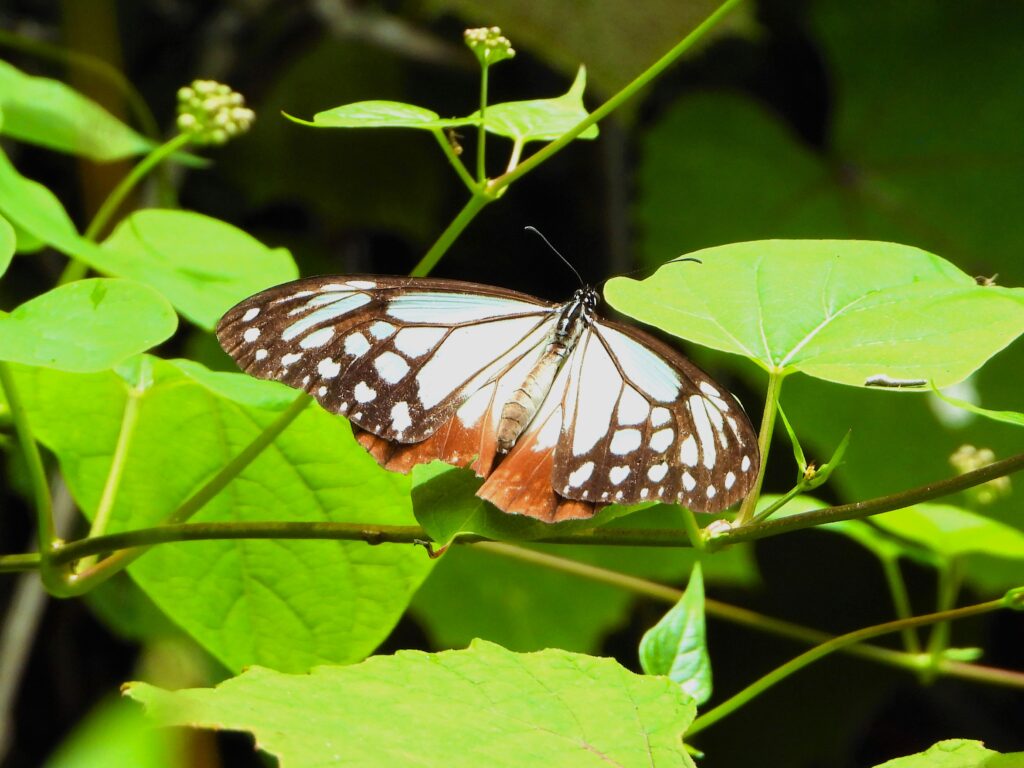
The Chestnut Tiger is one of the most fascinating butterflies in Japan.
Its pale bluish wings and slow, floating flight make it look delicate, but it is capable of remarkable long-distance movements.
Many move north during spring and early summer, while southward movements become more noticeable in autumn.
They can also be found in mountain and highland areas during summer.
The Chestnut Tiger is a good reminder that some butterflies in Japan do not simply stay in one local area throughout their lives.
Blue Admiral
Kaniska canace
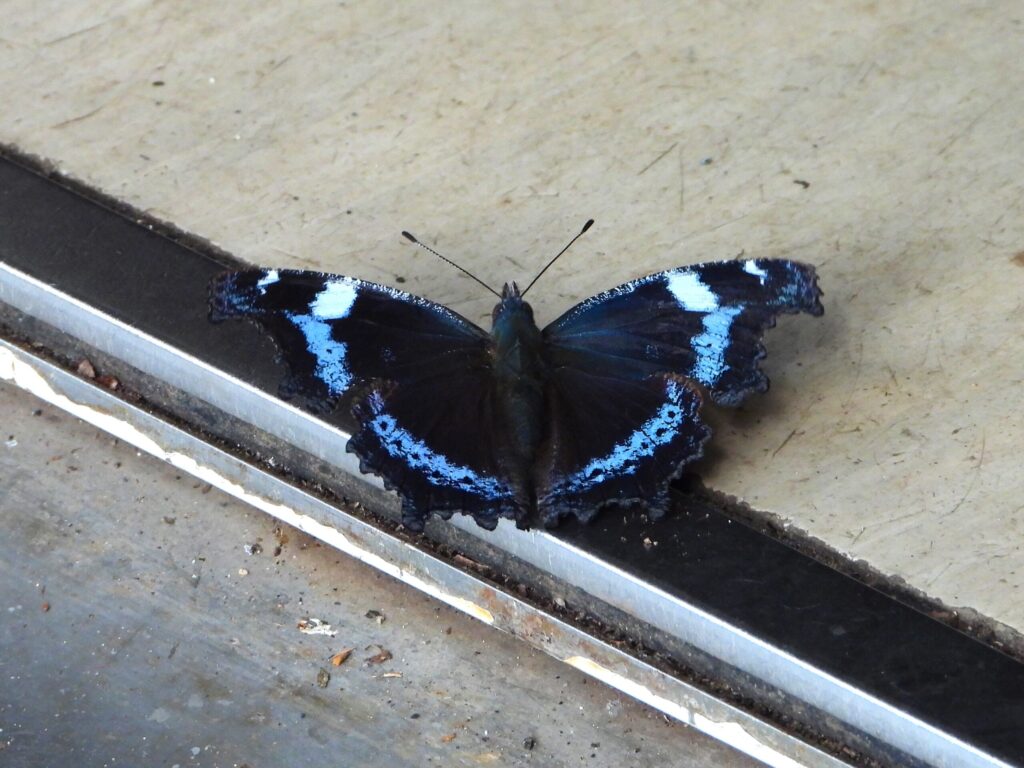
The Blue Admiral is a striking forest butterfly with a bright blue band across otherwise dark wings.
With its wings open, it is hard to miss.
Close them, however, and the underside blends surprisingly well with dead leaves and tree bark.
Blue Admirals also visit tree sap and overripe fruit, so flowers are not the only place to look for them.
Adults overwinter and may become active again on warm days in early spring.
Silver-washed Fritillary
Argynnis paphia

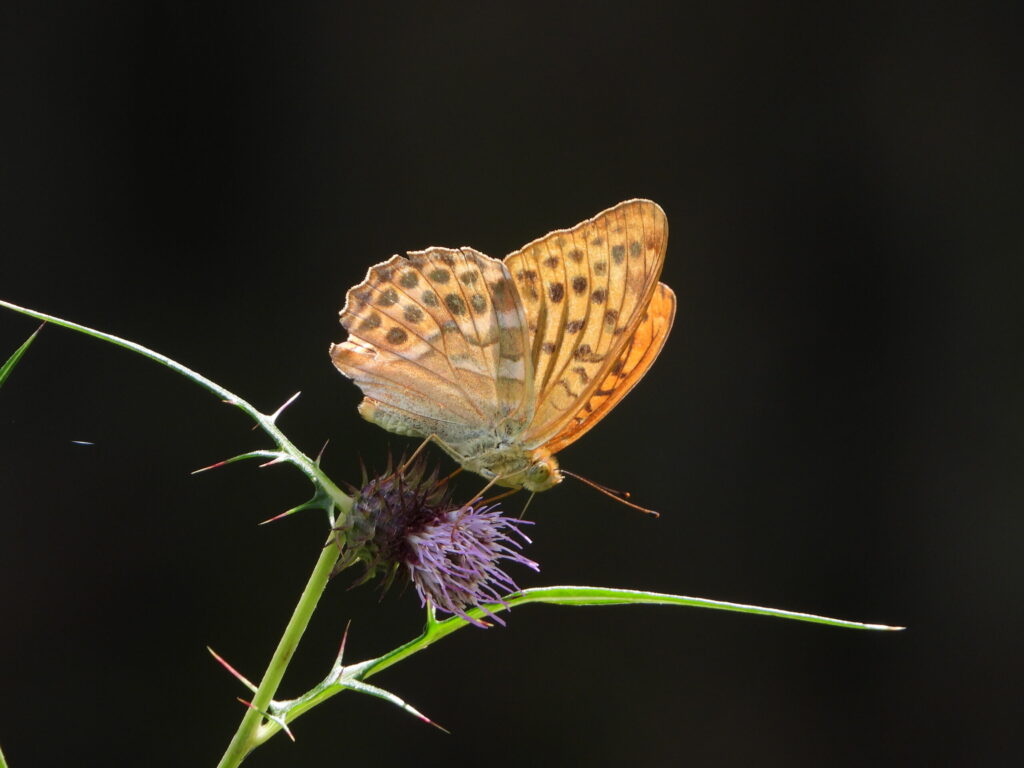
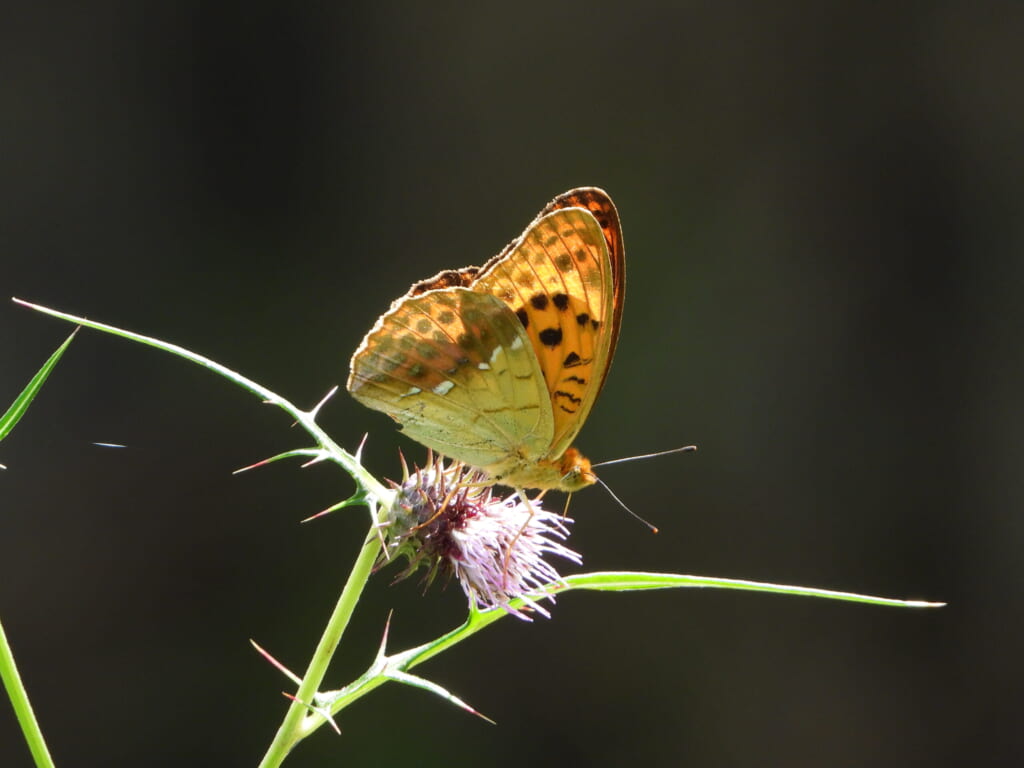
The Silver-washed Fritillary is a large orange butterfly often seen around forests and woodland edges.
It regularly flies along forest roads and sunny clearings in search of flowers.
I often see them feeding on thistles.
Sometimes several gather around the same patch of flowers, making them particularly noticeable when they are active.
Comma Butterfly
Polygonia c-album
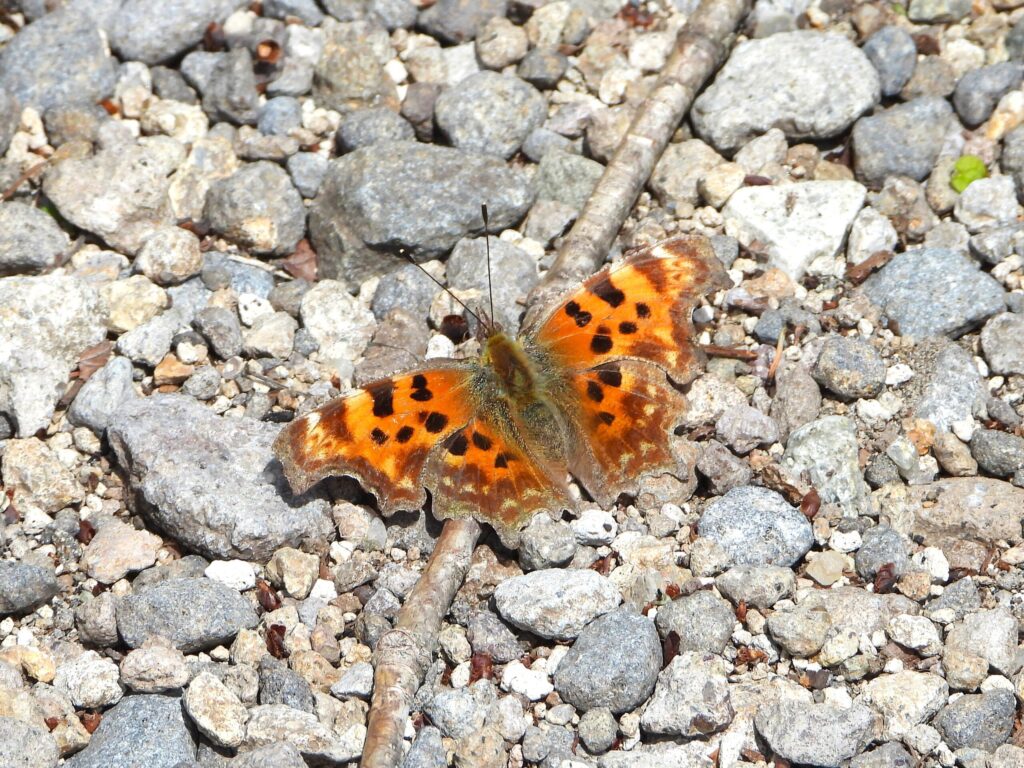
The Comma Butterfly has deeply scalloped wings and a small white C-shaped mark on the underside of the hindwing.
In Japan, it occurs from Hokkaido to Kyushu and is often encountered in cooler areas, including the mountains of Honshu.
With its wings closed, it looks remarkably like a dead leaf.
That camouflage makes resting individuals surprisingly easy to walk past.
Compton Tortoiseshell
Nymphalis l-album
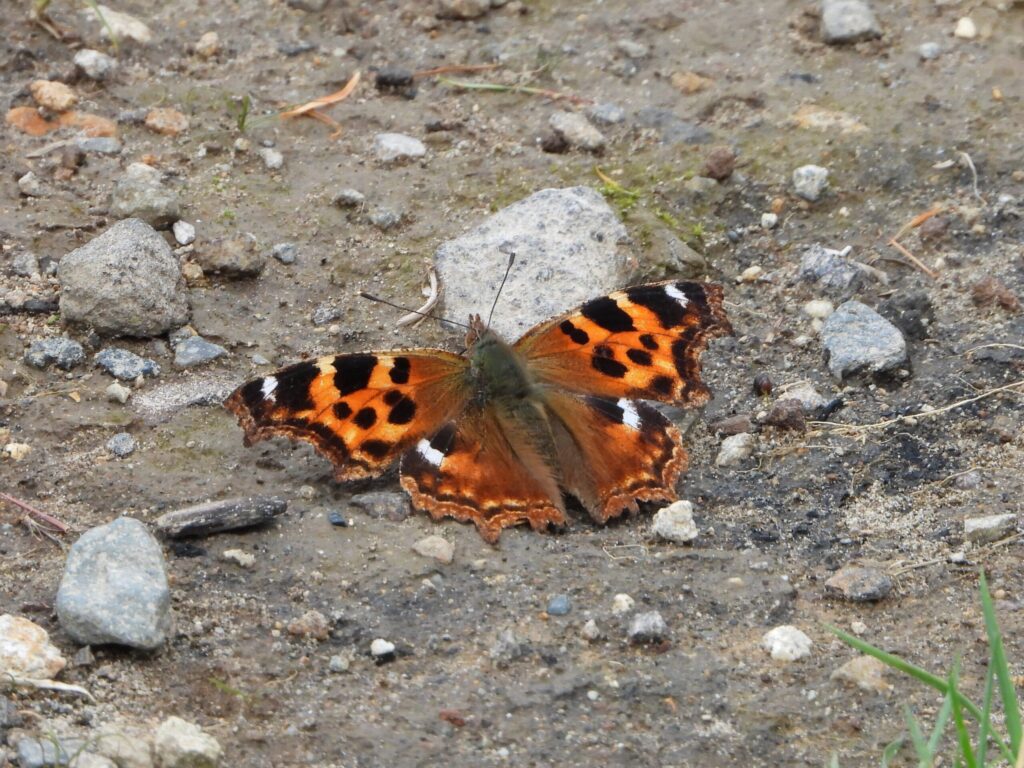
The Compton Tortoiseshell is a butterfly of cooler parts of Hokkaido and Honshu.
Look for it around deciduous woodland, forest roads, and stream valleys.
Adults overwinter, so it is possible to encounter them early in spring, when relatively few other butterflies are active.
They sometimes bask in sunny spots with their wings spread.
Mourning Cloak
Nymphalis antiopa
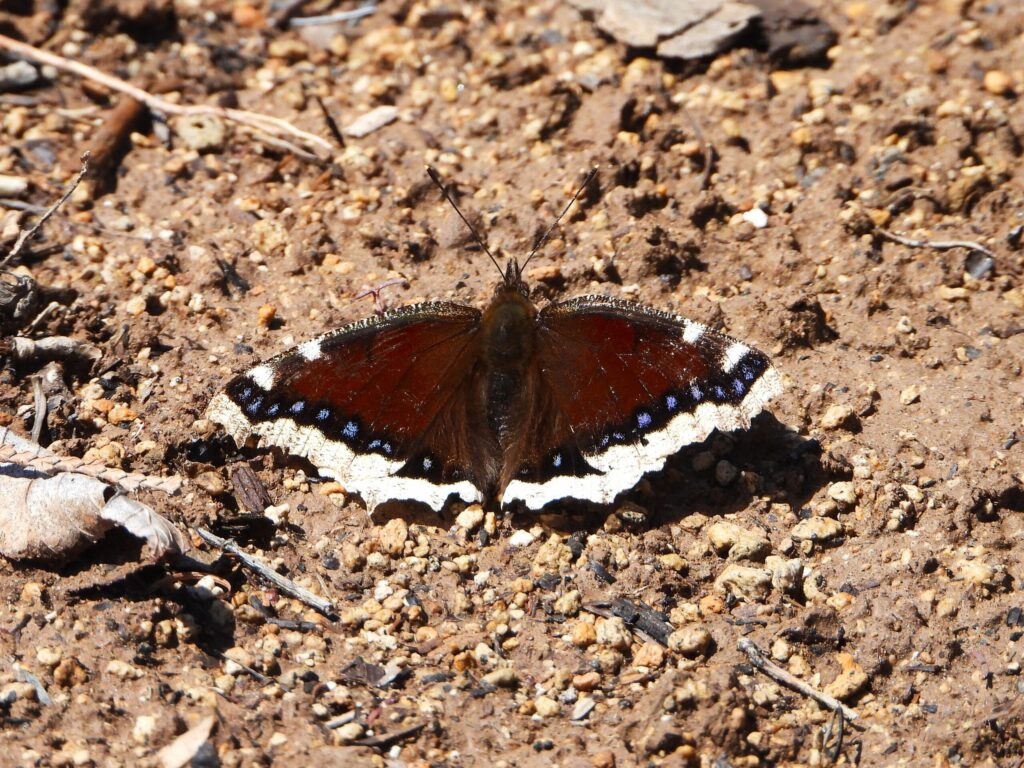
The Mourning Cloak is easy to recognize when it lands.
Its dark brown wings are bordered with pale yellow, with a row of blue spots just inside the edge.
Although the species has a very broad global range, in Japan it is mainly associated with cooler areas such as Hokkaido and mountain regions of Honshu.
It can fly surprisingly fast, but may stop on sunny forest roads and other open spots to bask.
Like several other tortoiseshell butterflies, it overwinters as an adult.
Peacock Butterfly
Aglais io
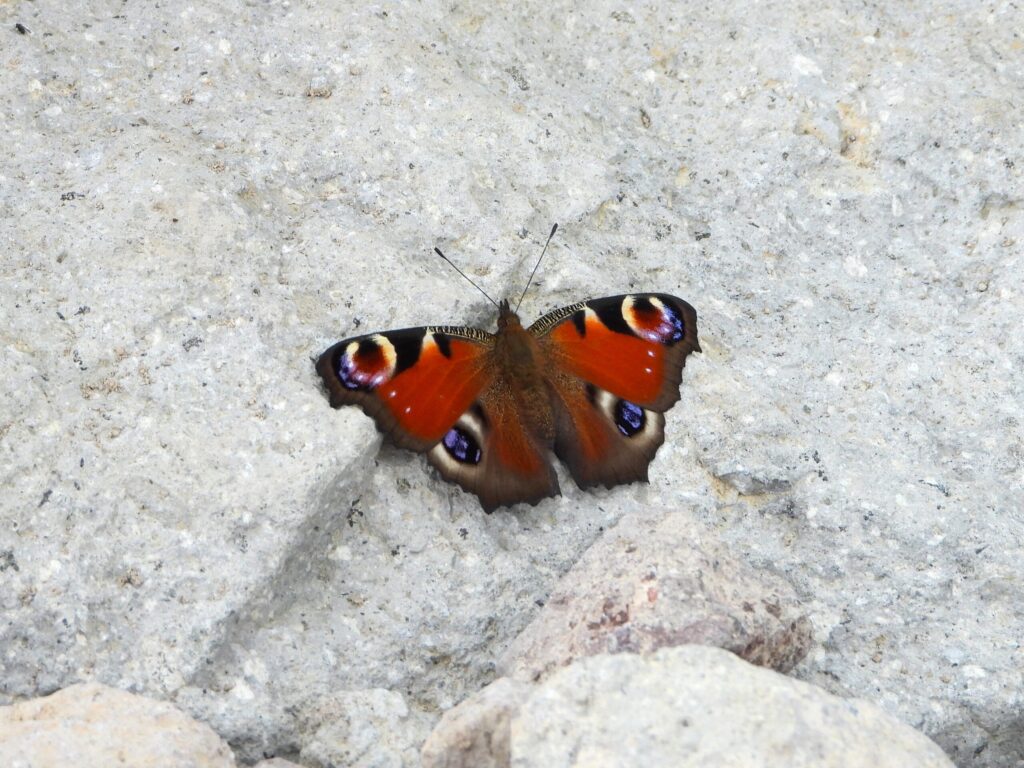
The Peacock Butterfly is one of the easiest Japanese butterflies to recognize once it opens its wings.
Each wing carries a large eyespot, creating a pattern that is difficult to mistake for anything else.
In Japan, it is mainly found in Hokkaido and cooler mountain or highland areas of Honshu.
When I photographed one, the eyespots were the first thing that caught my attention.
Large Tree Nymph
Idea leuconoe

The Large Tree Nymph is one of the most distinctive butterflies of Japan’s southern islands.
It is a large white butterfly marked with black, and its slow, floating flight is very different from the faster flight of many butterflies on the main islands.
I have seen this species on Ishigaki Island.
Its size and flight style immediately made the butterfly life there feel very different from what I usually see on Honshu.
Common Tiger
Danaus genutia

In Japan, the Common Tiger is mainly found in the southern Ryukyu Islands, particularly around the Miyako and Yaeyama Islands.
It can also appear farther north, although records outside its established range may involve wandering individuals.
The orange wings are crossed by bold black veins, and the butterfly is often seen around grasslands, roadsides, and flower-rich open areas.
Species like the Common Tiger make it immediately obvious how different the butterfly life of southern Japan can be from that of Honshu.
Swallowtail Butterflies in Japan
Japan has a good variety of swallowtails, and even a few well-known species show how different their habitats can be.
Asian Swallowtails are common around parks, gardens, and residential areas.
Maack’s Swallowtails are much more closely associated with forests and mountains.
Japanese Luehdorfia, meanwhile, is a spring specialist with a very short adult season.
If you want to see a particular swallowtail in Japan, choosing the right season and habitat is far more useful than simply looking for large butterflies.
When Is Butterfly Season in Japan?
Spring through autumn is the main butterfly-watching season across much of Japan.
However, timing changes considerably with latitude and elevation.
A species may appear several weeks earlier in a warm lowland area than it does in the mountains.
Spring
As temperatures rise, butterflies that spent the winter as adults begin moving again.
Blue Admirals, Compton Tortoiseshells, Mourning Cloaks, and Peacock Butterflies may all appear relatively early in the season.
Spring is also the only chance to see adults of short-season species such as the Japanese Luehdorfia.
For some butterflies, missing a few weeks means waiting until the following year.
Summer
Summer brings a wide variety of butterflies across much of Japan.
Forests can hold Maack’s Swallowtails and Silver-washed Fritillaries, while highlands and mountain areas often have species that are less likely to appear in the lowlands.
The peak season is different for every species, though, and hotter weather does not always mean better butterfly watching.
During midsummer, moving to higher elevations can make a big difference.
Autumn
Plenty of butterflies remain active into autumn.
It is also the season when southward movements of the Chestnut Tiger become especially noticeable.
In Hokkaido and at higher elevations, however, butterfly numbers begin dropping quickly as temperatures fall.
Winter
Butterflies become much harder to find during winter across most of Japan.
They have not disappeared.
Different species spend the cold season as eggs, larvae, pupae, or adults.
Adult-overwintering species such as the Blue Admiral and several tortoiseshells may occasionally become active during mild winter weather or in early spring.
Where Can You See Butterflies in Japan?
A flower garden is not the only place to look.
Different butterflies use very different habitats.
Urban Parks, Gardens and Residential Areas
These are some of the easiest places to start.
Flowers help, but the plants used by caterpillars can be just as important.
Asian Swallowtails, for example, are well adapted to human-dominated environments and can be seen even in large cities.
Satoyama and Woodland Edges
Places where woodland meets open ground are often excellent for butterflies.
Sunny forest edges provide flowers, shelter, and a transition between different habitats.
Some species, including the Japanese Luehdorfia, are closely associated with traditional satoyama landscapes.
Forest Roads and Stream Valleys
These are some of the places I check most often.
A mountain road can bring together forest, sunlight, flowers, water, and patches of damp ground within a very small area.
Do not ignore puddles.
Male Maack’s Swallowtails may come down to wet soil to take in moisture and minerals, sometimes gathering in groups.
Highlands and Mountains
Cooler highlands and mountain areas support butterflies that are less common or absent from warmer lowlands.
Peacock Butterflies, Mourning Cloaks, and Compton Tortoiseshells are all good examples.
In Japan, gaining elevation alone can change the butterflies around you.
Amami, Okinawa and the Yaeyama Islands
The butterfly community changes dramatically in the southern islands.
Large Tree Nymphs, Common Tigers, and other southern species give these islands a distinctly subtropical feel.
Compare a mountain in Hokkaido with Ishigaki Island and you are looking at two very different butterfly communities within the same country.
How to Find Butterflies in Japan
If you want to find butterflies, think about season and habitat, not just species names.
Warm, sunny days with relatively light winds are generally good conditions for butterfly activity.
Flowers are an obvious place to check, but they are only part of the picture.
When I am looking for butterflies, I also watch:
- sunny forest roads
- woodland edges
- stream valleys
- puddles and damp soil
- flower-rich areas, especially thistles
- open areas in the mountains
Different butterflies use different resources.
For Maack’s Swallowtail, wet ground can be productive.
For Silver-washed Fritillary, check flowers along woodland edges.
Blue Admirals are worth looking for around forest paths and tree sap.
For Peacock Butterflies and other cool-climate species, mountain areas are a better choice.
In other words, do not just look for flowers.
Look for the habitat the butterfly itself is likely to use.
If you are not sure which species you have found, take a few photographs rather than trying to identify it immediately.
If possible, photograph both the upper and underside of the wings. Those details can make identification much easier later.
Butterflies vs Moths in Japan

Butterflies and moths both belong to the order Lepidoptera.
Butterflies are generally active during the day and usually have antennae with clubbed tips.
Many moths are nocturnal and have a wider variety of antenna shapes, including thread-like and feathery forms.
But these are only general rules.
Some moths fly during the day, and many are just as colorful as butterflies.
So “daytime means butterfly” and “nighttime means moth” is not a reliable way to separate them.
For more about Japanese moths:
For some of Japan’s largest moths:
Explore More Insects in Japan
Japan has far more to offer than butterflies.
Beetles, moths, dragonflies, cicadas, mantises, and many other insects also change with the seasons and habitats.
Butterflies are a great starting point for seeing just how varied insect life in Japan can be.
For rhinoceros beetles, stag beetles, and other Japanese beetles:
You cannot see all of Japan’s butterflies in one place.
Spring satoyama, summer forest roads, the mountains of Hokkaido and Honshu, and the subtropical islands of the south all offer something different.
Change the season and change the location, and the butterflies change with them.
That is one of the best things about looking for butterflies in Japan.