Japanese Raccoon Dog (Nyctereutes viverrinus) – Wildlife of Japan
Introduction
The Japanese raccoon dog, commonly known as the tanuki, is a small wild canid native to Japan. It is one of the most familiar wild animals in the Japanese countryside and often appears in folklore, stories, and popular culture.
Scientifically known as Nyctereutes viverrinus, the tanuki is considered a species unique to Japan and is well adapted to a wide range of environments, from forests and farmland to green spaces near cities.
If you are interested in seeing tanuki in the wild, you may also enjoy this guide:
▶ Where to See Tanuki in Japan (Japanese Raccoon Dog)
Appearance
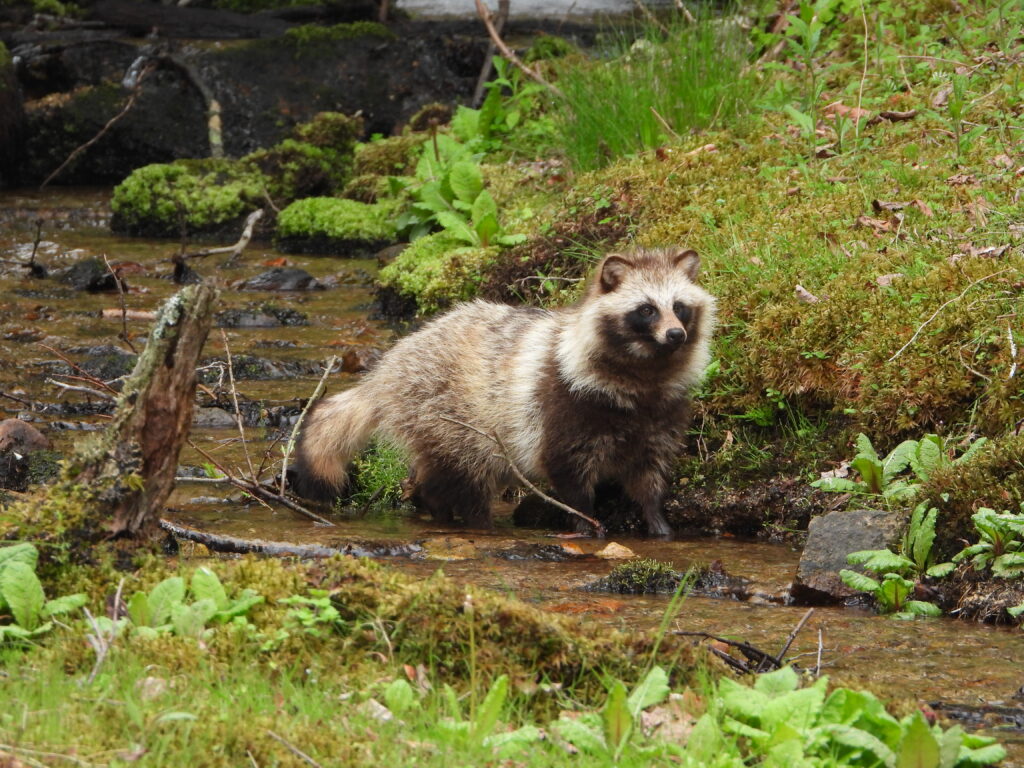
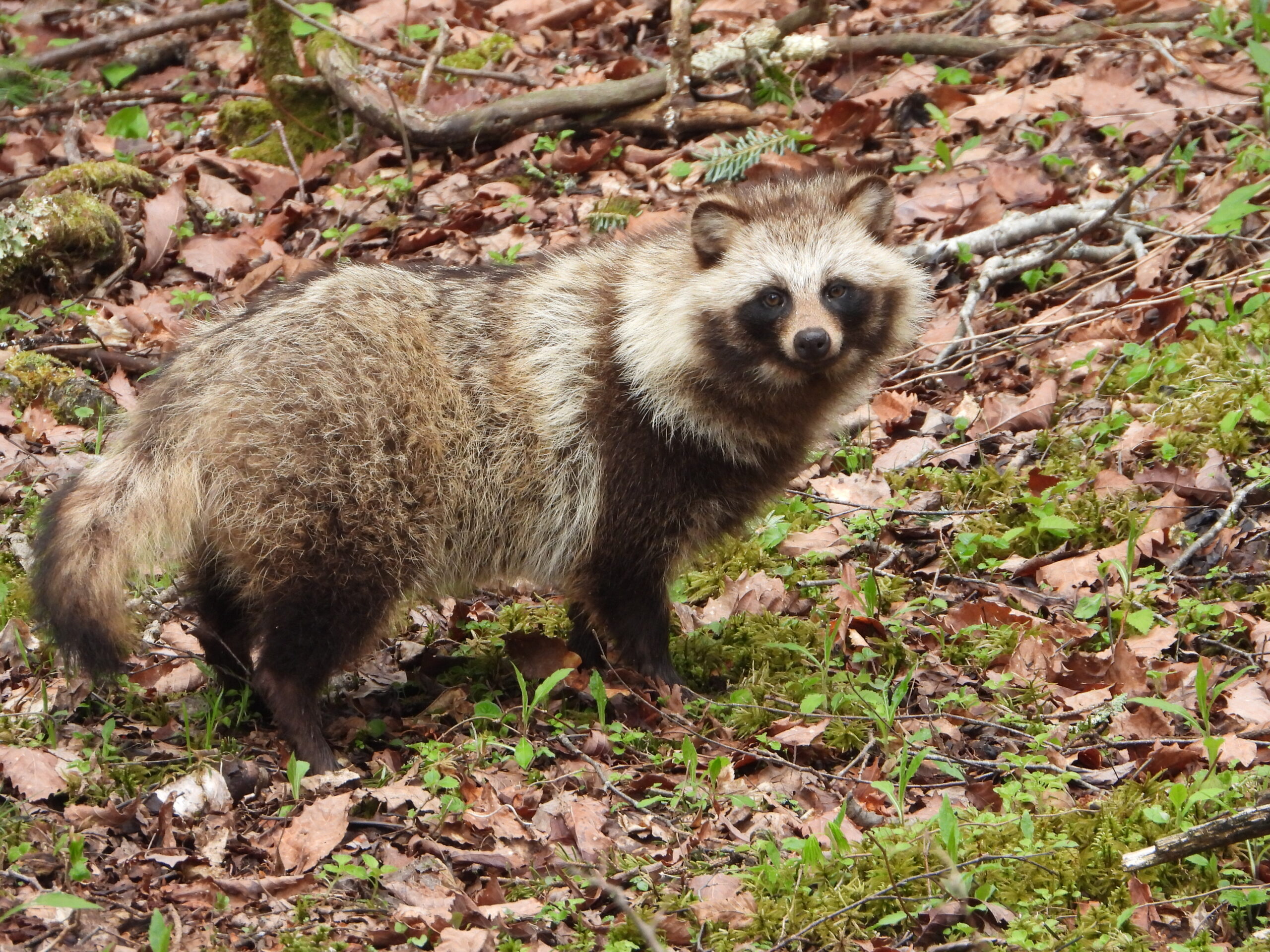
Tanuki are stocky animals with short legs, thick fur, and a bushy tail. One of their most distinctive features is the dark “mask” across the eyes, which often leads people to confuse them with raccoons, even though the two animals are not closely related.
Their fur usually ranges from gray-brown to yellowish tones, with darker legs and a paler muzzle. Seasonal molting can change their appearance significantly, making summer individuals look slimmer and shorter-haired than in winter.
Rounded ears, a compact body, and the masked face help distinguish tanuki from foxes and other similar mammals.
Habitat
In Japan they occur widely across Honshu, Shikoku, and Kyushu; Hokkaido holds a closely related northern form known as the Ezo-tanuki (N. v. albus). Tanuki thrive in forest edges, satoyama mosaics, river corridors, farmland margins, and even green spaces near cities. There is no native population in Okinawa.
Behavior
Tanuki are mostly nocturnal and crepuscular and typically travel as pairs or small family groups. They communicate with low growls and cat-like grumbles. In colder regions they enter a shallow winter dormancy, reducing activity and metabolism rather than undergoing deep hibernation.
Diet
Tanuki are opportunistic omnivores whose diet shifts with the seasons. They consume fruits and seeds (persimmons, ginkgo nuts, wild berries), insects and earthworms, small mammals, amphibians, and carrion; along streams and rivers they may also catch fish. Long-term studies in and around Tokyo show that plant foods dominate in some seasons, while animal prey becomes more important in others.
From my own field observation, I once watched a tanuki catching fish in a river. I hadn’t associated them with that behavior, and it was surprising as well as impressive—an excellent example of their flexible foraging.
Reproduction
Tanuki are generally monogamous. Breeding occurs from late winter to early spring, and gestation lasts about nine weeks. Litters typically range from four to six pups, though larger litters occur. Both parents defend the den and care for the young; pups are weaned at around one month and remain with the family for several more weeks.
Conservation
Tanuki remain common and adaptable in Japan, but they face significant risks from human activity. Wildlife–vehicle collisions are a major cause of mortality, and outbreaks of sarcoptic mange have affected some populations. Measures that reduce roadkill and maintain connected green spaces are beneficial.
Author’s Impression
The tanuki I encountered was catching fish in a river—a scene that left me surprised and deeply moved. Beyond the field, tanuki appear frequently in Japanese stories, folklore, and animation, which makes them feel like a true symbol of Japan.