
Ezo Red Fox (Vulpes vulpes schrencki): Hokkaido’s Wild
The Ezo red fox (Vulpes vulpes schrencki) is the red fox subspecies native to Hokkaido.
In Japan, it is the northern counterpart of the Japanese red fox (Vulpes vulpes japonica), which lives on Honshu, Shikoku, and Kyushu. Outside Hokkaido, the natural range of the Ezo subspecies also includes Kunashir and Etorofu in the southern Kuril Islands.
For visitors to Hokkaido, the Ezo red fox is one of the island’s most recognizable wild mammals.
I have encountered them many times in Hokkaido. I have often seen foxes walking through farmland around dusk, and I once saw one simply sitting on a school field.
Those experiences are a good reminder that the Ezo red fox is not only an animal of remote wilderness.
What Is an Ezo Red Fox?
The Ezo red fox is a subspecies of the widespread red fox (Vulpes vulpes).
Within Japan, Ezo red foxes occur naturally in Hokkaido, while the Japanese red fox, also known as the Hondo fox, occurs farther south.
An adult Ezo red fox has a head-and-body length of roughly 60–80 cm, with a long bushy tail measuring around 37–44 cm.
Body size varies considerably between individuals, so size alone is not a reliable way to distinguish an Ezo red fox from the foxes of mainland Japan.
Within Japan, location is the simplest clue: a native wild red fox in Hokkaido belongs to the Ezo subspecies.
How to Identify an Ezo Red Fox
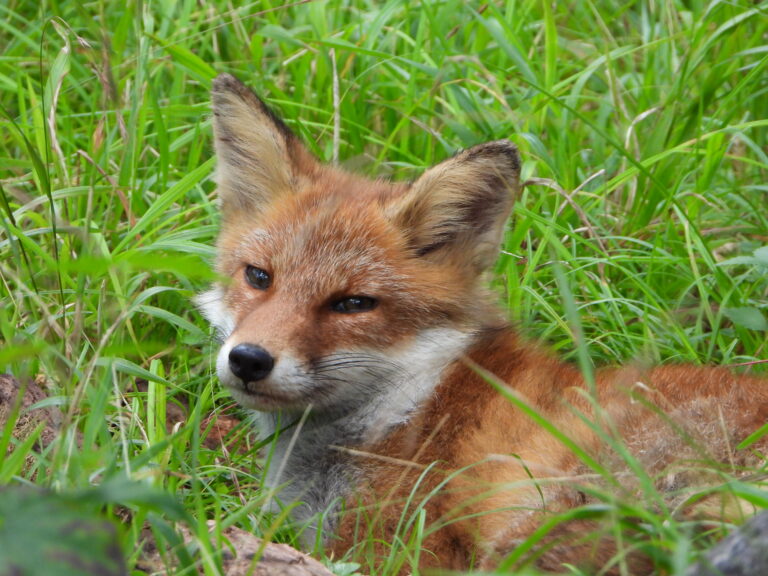
Ezo red foxes have the pointed face, upright ears, long legs, and bushy tail typical of a red fox.
Their coat is generally reddish-brown, while the underside is paler. The front of the lower legs is dark, and the large reddish-brown tail usually has a pale or white tip.
Their appearance changes noticeably between summer and winter.
Winter Coat
Winter is when Ezo red foxes develop their thickest and most impressive coat.
The dense fur makes both the body and tail look much fuller, and their reddish coat stands out clearly against the snow.
This fluffy winter appearance is the image many travelers associate with Hokkaido foxes.
Summer Coat
During the warmer months, much of the thick winter fur is shed.
Foxes can look considerably thinner, and their tails may appear much less fluffy.
This does not necessarily mean that the animal is starving or unhealthy. A normal summer coat can make the same fox look surprisingly different from its winter appearance.
Distribution and Habitat
Ezo red foxes are widely distributed across Hokkaido and can live in a broad range of environments.
They can be found in:
- forests
- grasslands
- agricultural areas
- coastal habitats
- mountainous areas
- rural communities
- urban areas
They are highly adaptable animals.
Wild foxes even live within Sapporo and may occasionally appear around parks, residential neighborhoods, and other green spaces.
This adaptability is one reason travelers sometimes encounter a fox unexpectedly while driving through farmland or a rural town rather than at a famous wildlife destination.
My Field Observations in Hokkaido
Many of my encounters with Ezo red foxes have happened in ordinary-looking landscapes rather than deep wilderness.
I have frequently seen foxes walking through agricultural areas around dusk.
On another occasion, I saw one sitting quietly on a school field.
One of my most memorable encounters was on the Notsuke Peninsula in eastern Hokkaido.
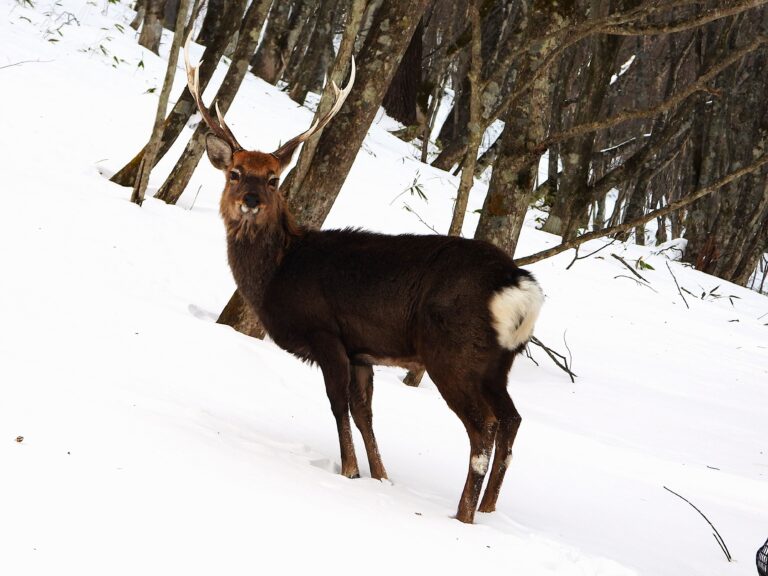
I saw an Ezo red fox near the coast with Ezo deer nearby. Seeing both species in the open coastal landscape was one of the wildlife encounters that stayed with me most strongly from Hokkaido.
Notsuke is also a memorable place because you can slowly drive through the peninsula while enjoying the scenery and watching for wildlife.
Experiences like these are why I do not think of the Ezo red fox only as an animal of remote forests.
Farmland, coastlines, quiet roads, and places surprisingly close to where people live can all be part of its world.
▶ Where to See Foxes in Hokkaido
Behavior
Ezo red foxes are generally more active from evening through the night and around dawn, although they can also be seen during the day.
Season makes a difference.
During spring and summer, adults raising young need to spend more time searching for food. This can make them more noticeable during daylight hours.
Outside the breeding and family period, foxes are often encountered alone.
During the winter breeding season, however, two foxes may sometimes be seen traveling together.
Wild foxes are naturally cautious animals.
If a fox repeatedly approaches people or vehicles expecting food, it may have learned to associate humans with feeding.
That behavior should never be encouraged.
What Do Ezo Red Foxes Eat?
Ezo red foxes are omnivores and take advantage of many different foods.
Their diet can include:
- voles and other small mammals
- hares
- birds
- insects
- fruit and berries
- fish
- carrion
Their diet changes with both season and habitat.
In Shiretoko, for example, foxes may eat rodents and deer carrion in spring, insects during summer, and fruits such as wild grapes in autumn.
Fish can also become an important food source where salmon and trout are available.
This flexibility is one reason Ezo red foxes can live in environments ranging from remote coastlines to agricultural areas.
Breeding and Life Cycle
The main breeding season is from around December to February.
During this period, pairs may become more noticeable.
Spring
Young are born in underground dens from around late March through April.
A litter commonly contains several pups.
By May and June, young foxes begin appearing outside the den.
Adults need to find enough food for the growing pups, so parent foxes may also become active during daylight.
If you find a den or young foxes, keep your distance and do not remain nearby for long periods.
Summer to Autumn
The pups continue growing through summer and gradually become more independent.
By autumn, young foxes begin separating from their parents and moving through the landscape on their own.
Dens are used mainly during the breeding and young-rearing period rather than as a permanent home throughout the year.
Ezo Red Foxes and People
Few Hokkaido mammals show the overlap between wild and human landscapes as clearly as the Ezo red fox.
Some foxes live far from settlements.
Others use farmland, parks, residential edges, and other environments shaped by people.
That adaptability makes them easier to encounter than many wild mammals, but it also creates problems when foxes begin associating people with food.
Never Feed a Wild Fox
Never feed a wild fox, even if it approaches your car or appears comfortable around people.
Foxes can quickly learn that people and vehicles provide easy food.
Once that happens, they may begin approaching roads and cars more frequently. This changes their natural behavior and increases the risk of traffic accidents.
A fox does not need to come close to be worth watching.
Echinococcus: What Visitors Should Know
Echinococcus is an important issue to understand in Hokkaido, but seeing a fox from a distance does not mean you have become infected.
The parasite Echinococcus multilocularis can live in the intestines of infected foxes, and parasite eggs are released in their feces.
Humans can become infected if these microscopic eggs are accidentally swallowed through contaminated hands, food, water, or other material.
Basic precautions are straightforward:
- do not touch or feed wild foxes
- do not touch fox feces
- wash your hands after outdoor activities
- do not drink untreated stream or river water
- thoroughly wash or cook wild plants, berries, and other foods collected outdoors
There is no reason to fear watching a fox from an appropriate distance.
The important point is to avoid direct contact with wild foxes and contaminated material.
Responsible Fox Watching
Ezo red foxes are still widely distributed in Hokkaido, but individual foxes face risks when their lives overlap with people.
Traffic is one of the most obvious examples.
Foxes sometimes cross or remain beside roads, and animals that learn to seek food from vehicles are placed at even greater risk.
When watching an Ezo red fox:
- keep your distance
- never feed it
- do not chase it for a photograph
- do not stop unsafely on a road
- stay away from dens and young foxes
- allow the fox to continue its natural behavior
Some of my strongest memories of Ezo red foxes are simple ones.
A fox walking through farmland at dusk.
A fox sitting quietly on a school field.
A fox near the coast with Ezo deer in the background.
There was no need to call them closer.
Watching a wild fox behave naturally is what makes the encounter memorable.
FAQ
Is the Ezo red fox found only in Hokkaido?
Within Japan, the Ezo red fox occurs naturally in Hokkaido.
Its natural range also includes Kunashir and Etorofu in the southern Kuril Islands.
What is the difference between an Ezo red fox and a Japanese red fox?
They are different subspecies of the red fox.
The Ezo red fox occurs naturally in Hokkaido, while the Japanese red fox occurs on Honshu, Shikoku, and Kyushu.
Size and appearance vary between individuals, so geographic distribution is the easiest distinction within Japan.
Are Ezo red foxes nocturnal?
They are generally more active at night and during dawn and dusk, but they can also be active during the day.
Daytime activity may become more noticeable during spring and summer when adults are raising young.
Do Ezo red foxes hibernate?
No.
They remain active throughout Hokkaido’s winter and grow a much thicker seasonal coat to cope with the cold.
Can you see Ezo red foxes in Sapporo?
Yes.
Wild foxes live within Sapporo and may occasionally appear in parks, residential neighborhoods, and other parts of the city.
Is it safe to photograph an Ezo red fox?
Yes, if you keep an appropriate distance and do not touch or feed it.
Use a telephoto lens rather than approaching the fox, and if you encounter one beside a road, stop only where it is safe and legal to do so.
Related Guides
▶ Where to See Foxes in Hokkaido