Crested Ibis (Nipponia nippon): Identification, Habitat and Behavior
The crested ibis is one of Japan’s most iconic birds.
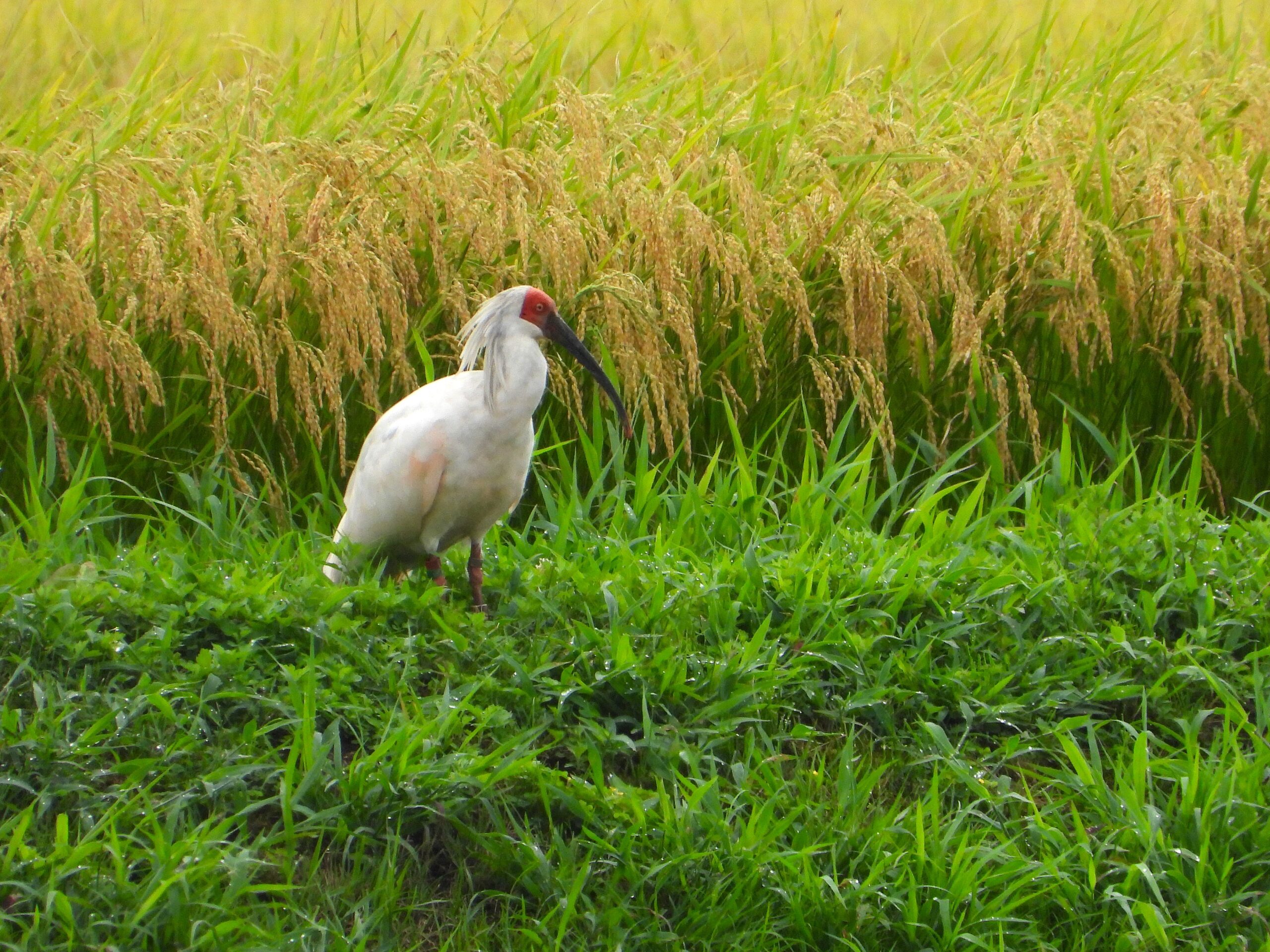
Known in Japanese as toki, its scientific name is Nipponia nippon. With a pale body, bare red face, long curved bill and soft pink wings, it is a distinctive bird once you know what to look for.
Crested ibises once lived across much of Japan, but they disappeared from the wild in the country in 1981.
After decades of captive breeding and conservation work, reintroduction began on Sado Island in 2008. Today, wild-born birds are breeding successfully there.
In 2026, releases also began in the Noto region of Ishikawa Prefecture, marking a new stage in the recovery of the species in Japan.
What Is a Crested Ibis?
The crested ibis is a large bird in the ibis family.
Its scientific name is Nipponia nippon, and it is the only living species in the genus Nipponia.
Adults are about 75 cm long, with a wingspan of around 130–140 cm and a weight of roughly 1.5 kg.
Despite its distinctly Japanese scientific name, the crested ibis is not endemic to Japan.
Historically, the species ranged across a much wider part of East Asia, including Japan, China, the Korean Peninsula, the Russian Far East and Taiwan.
In Japan, it was once found across much of the country.
During the 20th century, however, populations collapsed across much of the species’ former range.
Today, the crested ibis is closely associated with wildlife conservation in Japan, especially because of the long-running recovery program centered on Sado Island.
Appearance and Identification
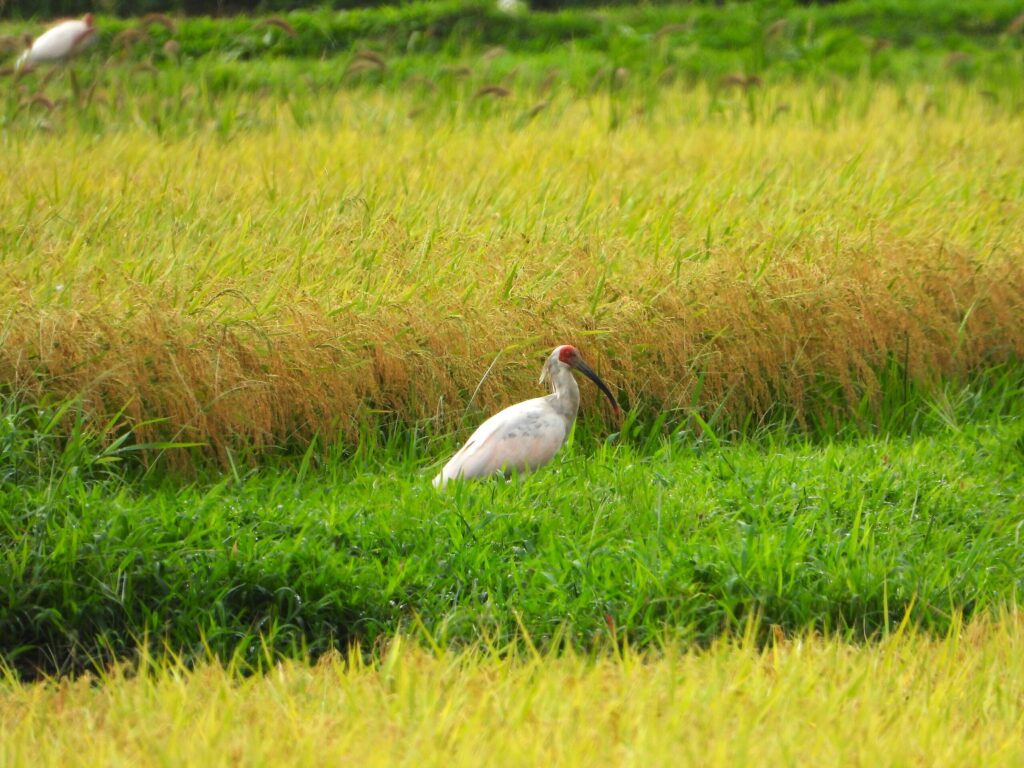
From a distance, a crested ibis can look like a large white bird.
In rice fields, it may even be mistaken at first for a heron or egret.
The key features to look for are:
- a bare red face
- a long, slender bill that curves downward
- red legs
- long crest feathers at the back of the head
- a pale body
- soft pink to peach tones in the wings and tail
The red face and curved bill are usually the easiest features to notice.
Herons and egrets generally have straight bills, while the crested ibis has a clearly downcurved bill.
The “crested” in Crested Ibis refers to the long feathers extending from the back of the head.
The bird is often even easier to recognize in flight.
When the wings open, pale pink tones become much more visible, giving the bird a very different appearance from the mostly white impression it gives on the ground.
Males and females look very similar, so it is difficult to tell them apart by appearance alone in the field.
The Pink Plumage Known as “Toki Color”
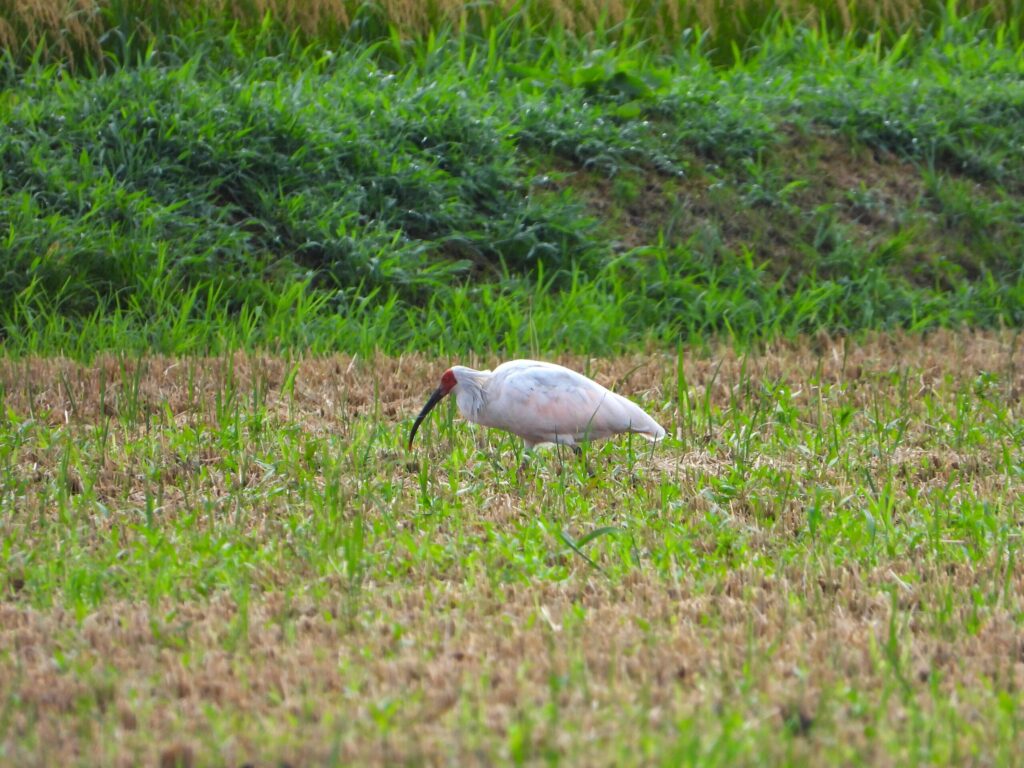
One of the most distinctive features of the crested ibis is its delicate pinkish plumage.
In Japan, this shade is known as toki-iro, or “toki color.”
It is not a bright pink.
Instead, it is a subtle mix of white, pale peach and soft orange-pink.
The color is especially noticeable in the flight feathers and tail.
Carotenoids obtained through the diet, including from crustaceans, play a role in producing this characteristic coloration.
When a crested ibis is standing with its wings folded, the pink can be surprisingly subtle.
Once the bird takes off, however, the color becomes much more obvious.
That contrast is one of the most memorable features of the species.
Why Crested Ibises Turn Gray During the Breeding Season
Crested ibises can look quite different depending on the season.
From autumn into winter, they appear much paler, with their white plumage and toki-colored wings easier to see.
As the breeding season approaches, the head, neck and back become gray to dark gray.
What makes this unusual is that the birds do not simply grow dark breeding feathers.
Instead, a dark substance from around the neck is rubbed onto the plumage, especially after bathing.
This stains the head, neck and back and gives breeding adults their grayish appearance.
Japanese conservation authorities describe this method of changing plumage color as a distinctive feature of the crested ibis.
After the autumn molt, the birds return to a much paler appearance.
Habitat
Crested ibises are closely associated with satoyama landscapes — traditional rural environments where farmland, wetlands, grassland and woodland exist close together.
Typical feeding areas include:
- rice fields
- wetlands
- irrigation channels
- fallow fields
- rice-field banks
- grassland
Trees are also important.
Crested ibises roost in trees and build their nests in them.
This means they depend on a mix of habitats rather than a single type of landscape.
They need places rich in prey as well as nearby trees for resting, roosting and breeding.
Protecting the crested ibis therefore also means protecting the wider rural ecosystem around it.
Diet
Crested ibises feed mainly on small animals.
Their diet includes:
- loaches
- frogs
- earthworms
- insects
- freshwater snails and other mollusks
- crabs and other crustaceans
Their long, curved bills are well suited to probing mud and shallow water.
While feeding, a crested ibis often walks slowly through a rice field or wetland, repeatedly pushing its bill into the mud in search of prey.
Healthy rice fields and wetlands are important because they support the small animals the birds depend on.
Behavior and Breeding
During the day, crested ibises spend much of their time feeding in rice fields, wetlands and other open areas.
At night, they roost in trees.
Outside the breeding season, several birds may feed together or form loose groups.
The breeding season generally runs from around February to July.
Pairs build nests in trees and raise their chicks there.
Today, the population on Sado is no longer made up simply of birds released by people.
Wild-born crested ibises are now reaching adulthood and successfully producing the next generation.
In 2026, 35 chicks were confirmed to have fledged in the wild on Sado Island, marking the 15th consecutive year of successful wild fledging.
For a species that once disappeared completely from the wild in Japan, that is a major milestone.
Distribution in Japan
The center of Japan’s established wild breeding population is Sado Island in Niigata Prefecture.
At the end of 2025, Japan’s Ministry of the Environment estimated that about 473 crested ibises were living in the wild on Sado.
Of these, an estimated 377 were at least two years old and potentially capable of breeding.
The estimation method changed from previous years, so the figure should not be compared directly with older estimates.
Japan’s crested ibis distribution changed again in 2026.
On May 31, eight birds were released in the Noto region of Ishikawa Prefecture, followed by another 10 on June 14.
That first mainland release involved a total of 18 birds.
Some of those birds later moved beyond Ishikawa Prefecture.
So it is no longer accurate to say that Sado Island is the only place in Japan where wild crested ibises occur.
Sado, however, remains the center of Japan’s established wild breeding population.
Extinction in the Wild and Reintroduction in Japan
The recovery of the crested ibis in Japan has taken decades.
The species was once widespread across the country, but numbers fell sharply from the late 19th century onward.
By the 20th century, only a small number remained.
In 1981, the last five wild crested ibises in Japan, all living on Sado Island, were captured for captive breeding.
At that point, the species disappeared from the wild in Japan.
That same year, a tiny surviving wild population of seven birds was discovered in China.
Cooperation between Japan and China later became crucial to the recovery of the species in Japan.
In 1999, a chick named Yuuyu hatched from a pair of crested ibises provided by China, marking the first successful artificial hatching of the species in Japan.
The birds from China were not a different species from the crested ibises that had lived in Japan.
They were the same species, Nipponia nippon.
Kin, the last surviving crested ibis born from Japan’s original wild population, died in captivity in 2003.
The crested ibises living in Japan today descend from birds provided from China.
Once captive breeding became successful, the next goal was to return the species to the wild.
In September 2008, the first 10 birds were released on Sado Island.
Wild breeding was later confirmed, and the population gradually grew into the several hundred birds now living there.
In 2026, the reintroduction program expanded to mainland Japan with releases in the Noto region.
Conservation Status
The recovery of the crested ibis is one of Japan’s most notable wildlife conservation stories.
In 2026, Japan’s Ministry of the Environment changed the species’ national Red List category from:
Critically Endangered (CR) to Endangered (EN)
This reflects an improvement in its status within Japan.
It does not mean the crested ibis is now safe from extinction.
The species is still threatened and remains dependent on continued conservation.
Rice fields and wetlands need to support enough prey.
Trees used for nesting and roosting need to remain available.
Wild birds also need enough space to feed and breed without excessive disturbance from people.
The recovery has come a long way, but it is still a work in progress.
Where to See Crested Ibis in Japan
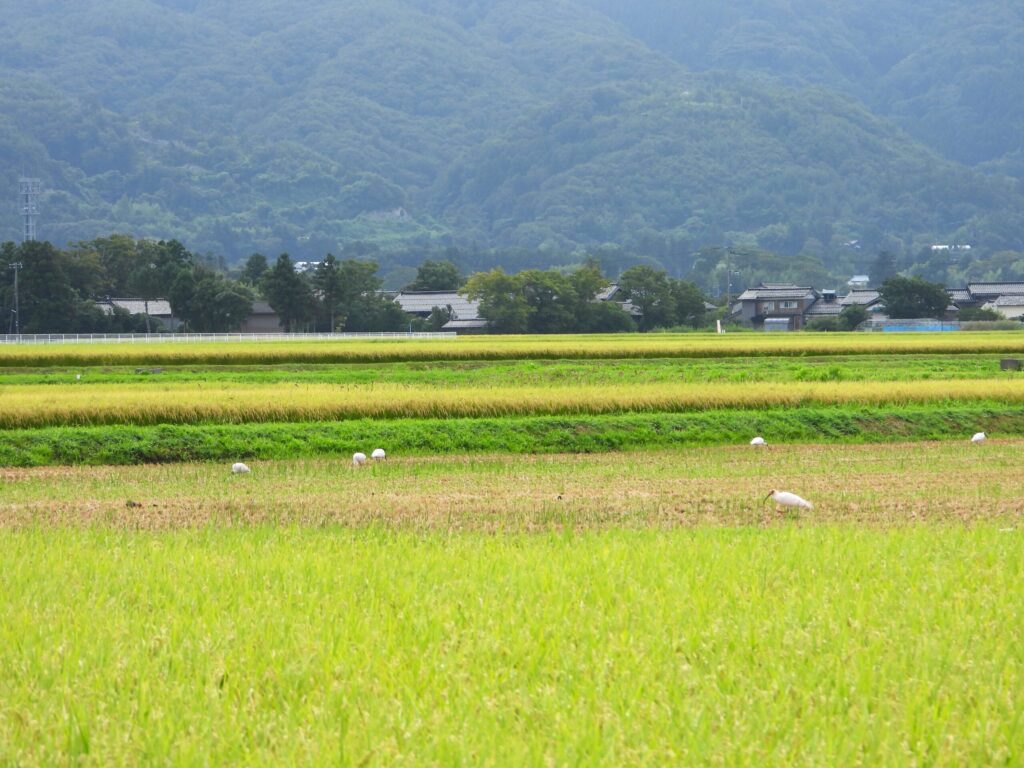
The best-known place to see wild crested ibises in Japan is still Sado Island.
Sado supports an established wild breeding population and remains the center of crested ibis recovery in the country.
Since 2026, released birds have also been living on mainland Japan.
However, authorities do not publish detailed location information for the Noto birds, partly to reduce disturbance and give them the best chance to settle.
For that reason, this species guide does not provide exact locations for tracking down mainland birds.
If your goal is to see wild crested ibises on Sado, I have a separate practical guide covering where to look, how to search, observation facilities and photography etiquette.
▶ Where to See Wild Crested Ibis on Sado Island, Japan
That guide focuses on the practical side of finding and watching wild birds.
My Experience Seeing Wild Crested Ibis on Sado Island
I visited Sado Island in September and was able to watch and photograph wild crested ibises.
One of the most memorable sights was seeing them in the island’s agricultural landscape.
I photographed a crested ibis with rice fields in the background, and the scene made it easy to see how naturally the species now fits into Sado’s rural environment.
What stood out even more was the color in flight.
On the ground, the bird looked surprisingly pale.
But when it opened its wings, the soft toki-colored plumage suddenly became much more visible.
I had seen the color in photographs before, but watching a wild bird reveal it in flight made a much stronger impression.
For practical details about finding wild birds on Sado, including what I learned from visiting in September, see my full Sado crested ibis watching guide.
Nipponia nippon — A Symbol of Wildlife Reintroduction in Japan
The scientific name of the crested ibis is Nipponia nippon.
It is a name that feels unmistakably connected to Japan.
But the bird’s importance in the country goes far beyond its name.
Crested ibises once lived across Japan, disappeared from the wild, were bred again in captivity and were eventually returned to nature.
Today, wild-born birds on Sado are raising new generations of their own.
Since 2026, the reintroduction effort has also begun to expand to mainland Japan.
The crested ibis is more than a rare and beautiful bird.
It has become one of Japan’s clearest symbols of bringing a lost wild species back into the landscape.