Japanese White-eye (Zosterops japonicus) – Wildlife of Japan
Introduction
The Japanese White-eye, also known as the Warbling White-eye in some classifications, is one of the most familiar small birds in Japan. You’ll often see it moving quickly through trees in parks, gardens, and forests.
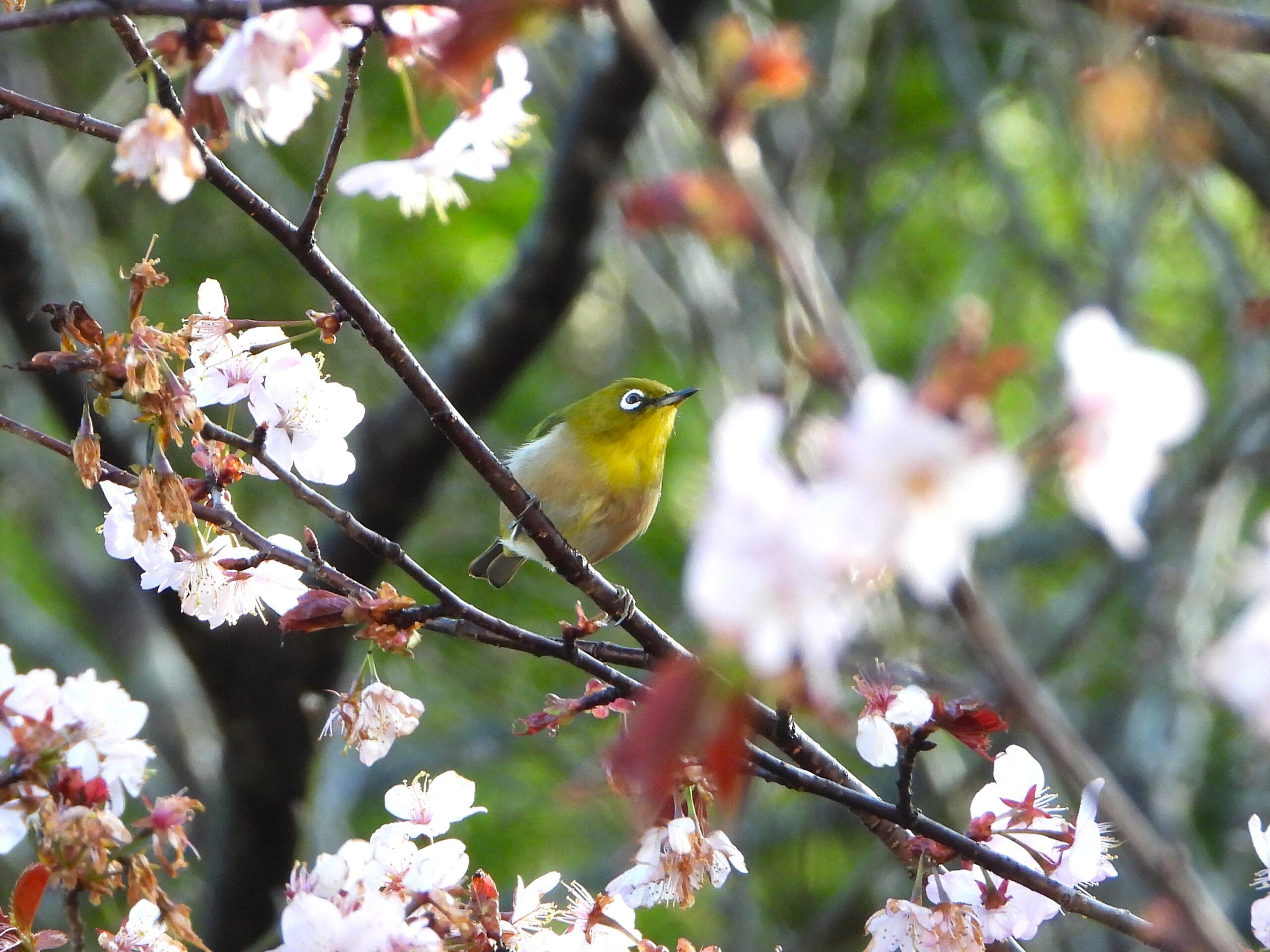
With its bright green body and distinctive white eye-ring, it becomes especially noticeable in spring, when it gathers around flowering trees such as plum and cherry blossoms.
Appearance
This is a very small bird, measuring about 12 cm in length.
It has olive-green upperparts, a yellowish throat, and pale underparts.
The most recognizable feature is the bold white ring around the eye, which gives the bird its name. Males and females look almost identical in the field.
Its slim body and fine bill are well suited for feeding on insects and flowers, and it moves quickly and lightly through branches.
Habitat & Distribution
In Japan, the Japanese White-eye is widely distributed from central Hokkaido southward, though it becomes less common in the far north.
It prefers woodland and forest edges, especially in lowland and hilly areas. However, it adapts very well to human environments and is commonly found in city parks, gardens, shrine grounds, and residential areas.
Because of this adaptability, it is one of the easiest birds to see in Japan.
Where to See in Japan
You can find Japanese White-eyes in many everyday locations, including:
- Urban parks
- Temple and shrine grounds
- Botanical gardens
- Woodland trails
- Residential areas with trees
They are especially easy to spot when flowers are in bloom. Camellia, plum, and cherry blossoms are some of the best places to look.
Watch the outer branches of flowering trees — small birds moving quickly from flower to flower are often Japanese White-eyes.
Behavior
Japanese White-eyes are active and constantly moving. They usually travel in pairs, and outside the breeding season they may form small flocks.
They spend much of their time searching leaves, branches, and flowers for food. You’ll often see them hanging upside down or clinging to thin twigs.
Their soft, high-pitched calls can help you locate them even when they are hidden in dense foliage.
Diet
This species has a varied diet, including:
- Insects such as aphids
- Spiders
- Fruits
- Nectar
- Pollen
Their feeding on nectar is especially important. As they move between flowers, they help transfer pollen, playing a role in pollination.
Reproduction
The breeding season is mainly from April to June.
Pairs build a small, cup-shaped nest using moss and plant fibers, often held together with spider silk. The nest is usually placed in shrubs or low branches.
A typical clutch consists of 3 to 5 eggs.
Conservation
The Japanese White-eye is a common and widespread species in Japan, and overall it is not considered threatened.
However, not all populations are equally secure. The Daito subspecies (Zosterops japonicus daitoensis) is listed as Near Threatened in Japan’s 2026 Red List.
Historically, the species was also kept as a cage bird, and strict regulations now limit the capture of wild individuals.
Author’s Impression
The Japanese White-eye is one of the birds that truly represents spring in Japan.
At first, it may seem small and easy to overlook. But once you learn how it moves and sounds, you start noticing it everywhere — especially around flowers.
It’s a perfect bird for beginners, but also one that experienced birdwatchers never get tired of seeing.