Japanese Giant Flying Squirrel (Petaurista leucogenys) – Wildlife of Japan
Introduction
The Japanese giant flying squirrel is one of Japan’s most impressive nocturnal mammals. With a body about the size of a small cat and a broad gliding membrane, it moves silently between trees in the darkness. This species is endemic to Japan and depends on mature forests with large tree cavities and continuous canopy, especially on Honshu, Shikoku, and Kyushu. It often lives surprisingly close to towns, particularly in shrine groves and well-managed satoyama.
Appearance
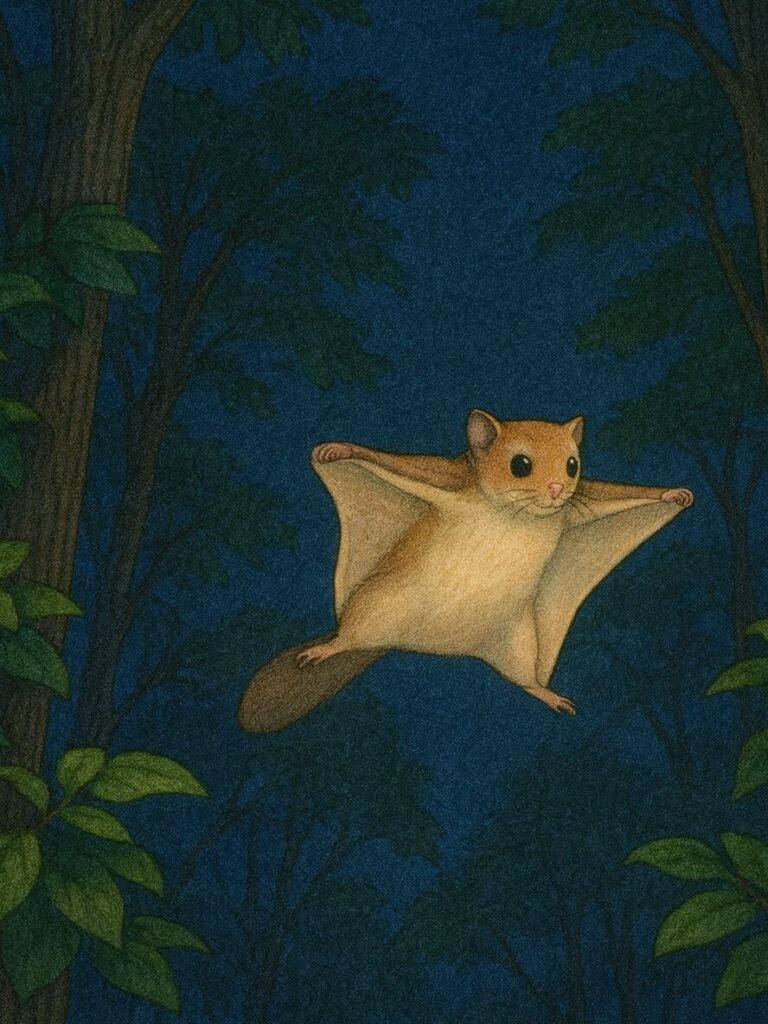
The Japanese giant flying squirrel is one of the world’s largest flying squirrels. Adults usually have a head–body length of around 25–50 cm and a tail of about 30–40 cm. Body mass generally ranges from 700 g to 1,500 g. It is covered with dense fur: the upperparts are brown to grayish, while the underparts are paler. A wide patagium stretches from the wrists to the ankles, allowing long glides between trees. The eyes are large for improved night vision, and the fluffy tail acts as a stabilizer in flight. Compared with the much smaller Japanese dwarf flying squirrel, this species is significantly bulkier.
Habitat & Distribution
This species is native and fully endemic to Japan, found only on Honshu, Shikoku, and Kyushu. It inhabits temperate broadleaf forests, mixed forests, and some evergreen forests with tall, mature trees. It particularly requires tree cavities for nesting and a continuous canopy for safe gliding. Although strongly linked with mountain forests, it can also survive in secondary woodlands, village forests, and shrine groves if suitable old trees remain. Areas lacking large trees or with heavily fragmented canopy are generally avoided.
Behavior
The Japanese giant flying squirrel is strictly nocturnal and spends almost its entire life in the forest canopy. During the day, it rests in tree hollows or leaf-lined nests. After sunset, it becomes active and moves through the treetops to feed. Movement includes climbing, walking along branches, and gliding. Typical glides are around 20–30 m, but glides exceeding 100 m can occur when jumping from higher points. This species is mostly solitary. Females usually occupy home ranges around 1 ha, while males range more widely—often overlapping with several females.
Diet
This species is primarily herbivorous. It feeds on a wide variety of plant parts including leaves, buds, flowers, fruits, acorns, and seeds. Seasonal shifts are clear: fresh buds and young leaves dominate in spring; nuts, seeds, and fruits are crucial in autumn and winter. It has a large cecum and elongated digestive system suitable for digesting fibrous leaves. A notable behavior called “leaf folding” is often observed, where a squirrel folds a leaf into a compact shape before eating it.
Reproduction
Breeding typically occurs twice a year in many populations. After a gestation of about 74 days, females give birth to one or two young inside tree cavities lined with soft material. The young are altricial and remain in the nest for several weeks. Weaning occurs around 80–90 days after birth. Juveniles begin making short glides near the nest tree before becoming fully independent. Sexual maturity is reached at about 21–22 months, giving this species a relatively slow population growth rate.
Conservation
The Japanese giant flying squirrel is currently listed as Least Concern on the IUCN Red List. However, local declines are possible where forests become fragmented or old trees with cavities are lost. Development projects and changes in satoyama management can break up gliding routes, leaving small patches isolated. Conservation efforts that preserve large, cavity-bearing trees and maintain continuous canopy are essential not only for this species but also for many other forest-dependent animals in Japan.
Author’s Impression
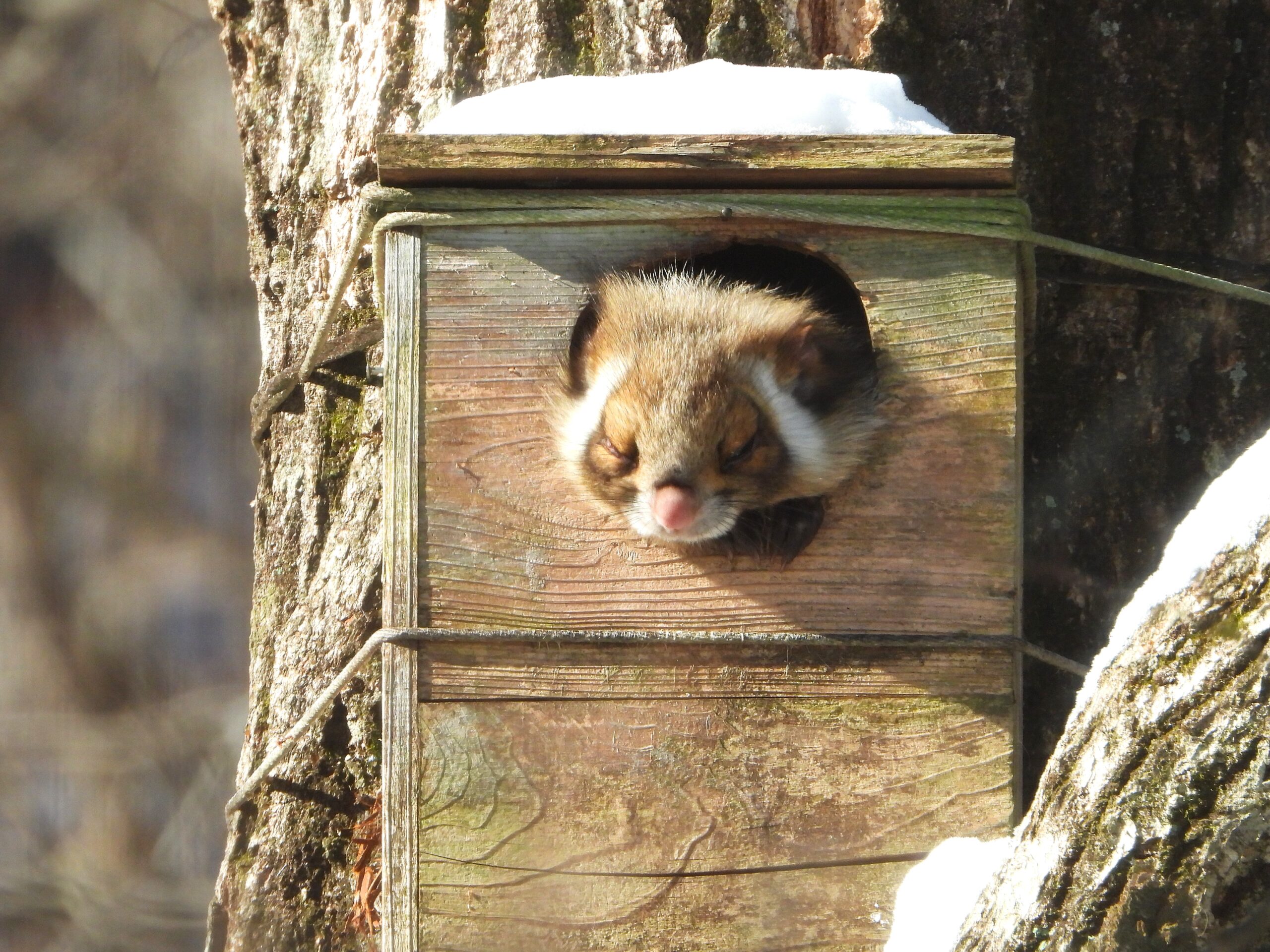
I installed a nest box for Japanese giant flying squirrels in my garden, and a wild squirrel actually came to use it. I was able to photograph that moment, and it became a very special and heart-warming memory for me. Because they are nocturnal, we rarely see them. That is why having one visit so close to home felt truly amazing. In this photo, you can only see the face of the squirrel, so I have included an additional image below to help you imagine what they look like when gliding or moving around the trees.