Joro Spider (Trichonephila clavata) – Wildlife of Japan
Introduction
The Joro spider is one of the most recognizable large orb-weaving spiders in Japan. It becomes especially noticeable from late summer to autumn, when adult females build massive webs along forest edges, riversides, parks, and even urban green spaces.
The Japanese name “Jorō-gumo” is sometimes confused with a spider yokai from folklore. This article focuses on the real animal: Trichonephila clavata, a true orb-weaving spider widely distributed in East Asia.
Appearance
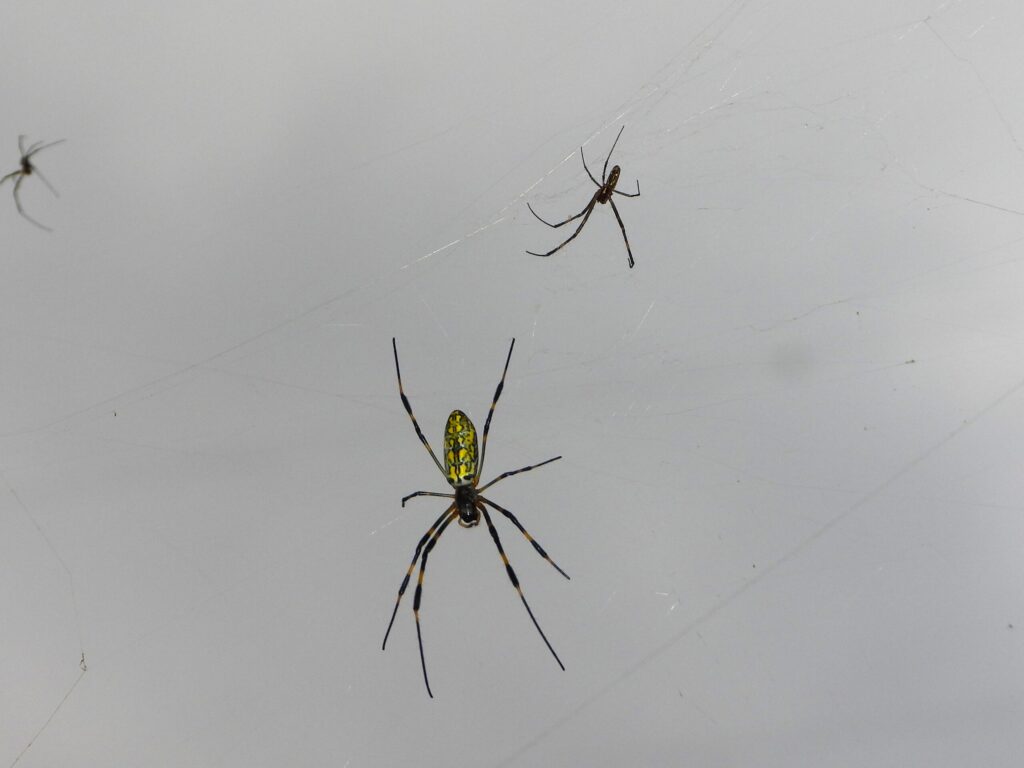
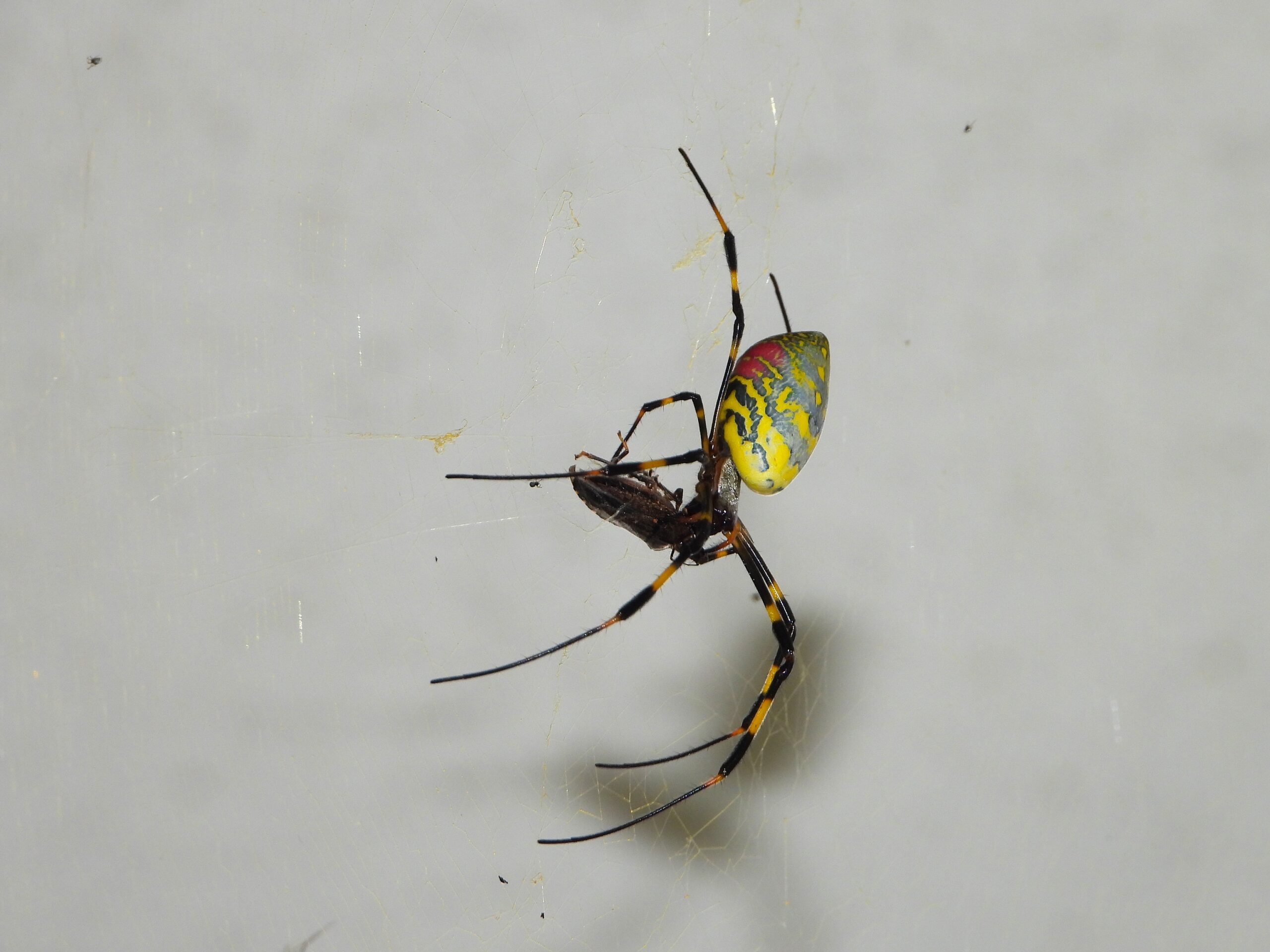
Adult females are very large, with long legs and striking coloration. The legs show bold yellow-and-black banding, and the abdomen has a vivid, eye-catching pattern. Once seen, the species is hard to forget.
Males are dramatically smaller than females and much less conspicuous in color. In many cases, they go unnoticed unless one closely examines a female’s web.
As a field clue in Japan, a very large orb web with a brightly colored, oversized spider at its center in autumn is highly likely to belong to the Joro spider.
Habitat & Distribution
The Joro spider is native to East Asia and is found in Japan, Korea, China, and Taiwan. Within Japan, it is recorded across much of the country except Hokkaido.
It is most commonly associated with warm lowland environments and green spaces close to human activity. Areas with abundant flying insects and solid anchor points for large webs—such as trees, shrubs, fences, railings, and cables—are particularly suitable habitats.
Behavior
The Joro spider is a classic orb-weaver, constructing a circular web to capture flying insects. Females are responsible for building and maintaining the large capture webs. Mature males typically do not build their own webs; instead, they enter female webs to seek mating opportunities.
Seasonal changes strongly affect how the species is observed:
- Spring to early summer: spiderlings emerge from overwintered eggs and disperse
- Late summer to autumn: females grow large and highly visible, and mating activity occurs
- Late autumn: females produce egg sacs, and adults die as temperatures drop
Diet
The Joro spider is a carnivorous predator that mainly feeds on flying insects caught in its web. Rather than specializing on a single prey type, it captures a wide variety of insects that pass through its hunting area.
Because of the extreme size difference between males and females, the ecological role of prey capture is largely carried out by the much larger females.
Reproduction
Reproduction takes place primarily in autumn, when adult females reach their maximum size and males actively search for mates.
A well-supported life-history trait of this species is that females lay egg sacs containing several hundred eggs. The species overwinters in the egg stage, not as adults.
Conservation
In Japan, the Joro spider is generally considered common in suitable habitats. However, this does not mean it is found everywhere, as its visibility depends strongly on season and local environmental conditions.
Outside Japan, the species has established populations as an introduced spider in some regions, which has drawn scientific and public attention.
Regarding human safety, available evidence indicates that bites are very rare, and when they do occur, symptoms are typically mild and localized.
Author’s Impression
The first impression most people have when encountering a Joro spider is simply how large it is. Not only the spider itself, but also the sheer size of its web creates an overwhelming sense of presence.
In autumn parks and forest edges, it often makes people stop and look twice. Seeing such a large invertebrate living quietly in everyday Japanese landscapes is a powerful reminder of how much wildlife still exists right beside us.