Goldcrest (Regulus regulus) – Wildlife of Japan
Introduction
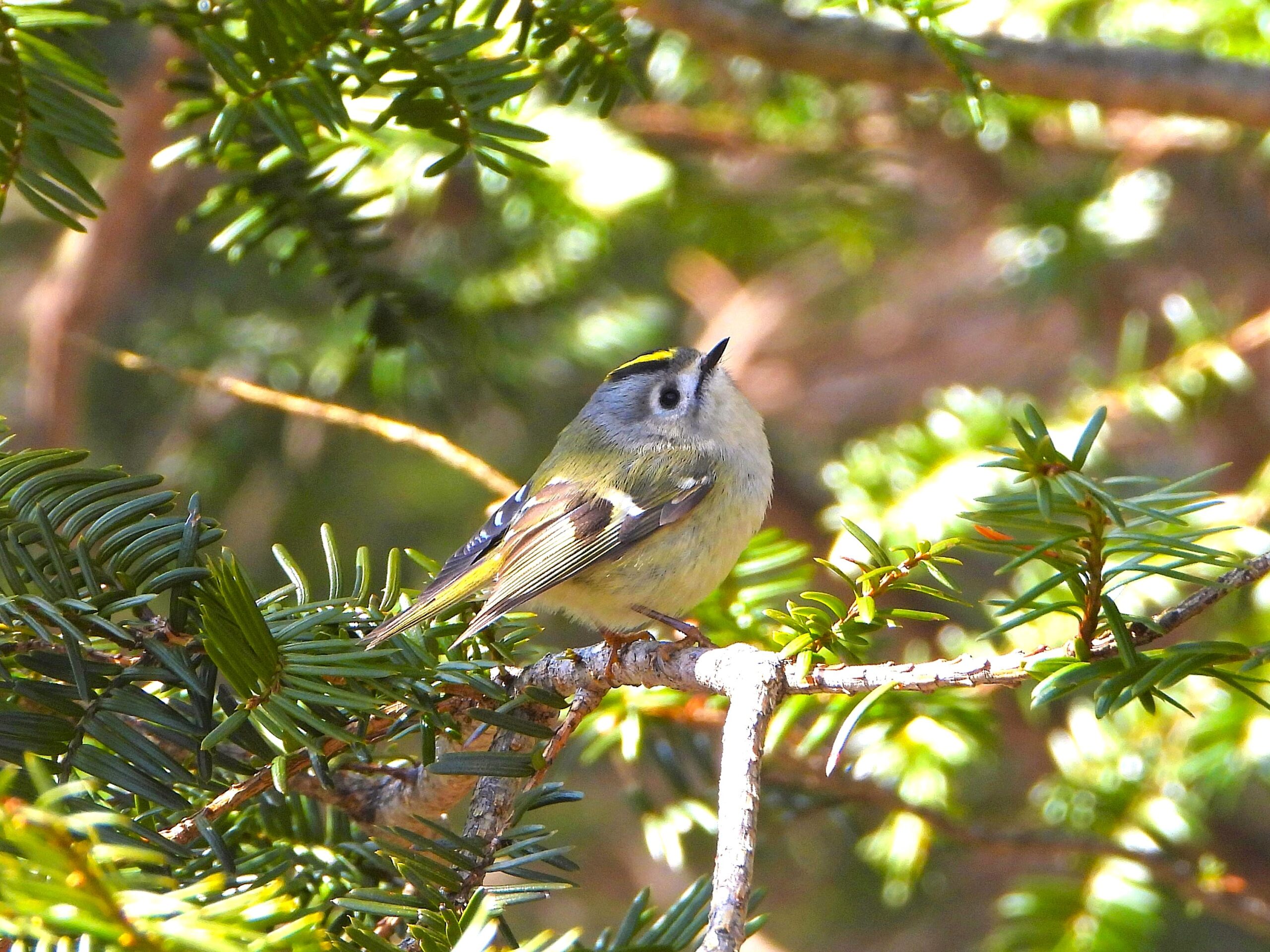
The Goldcrest, called Kikuitadaki in Japanese, is Japan’s smallest resident bird and a symbol of the country’s high-elevation conifer forests. Its name means “chrysanthemum on the head,” referring to the flower-like golden crown that glows as it flits among the trees. In addition, its lively movements make it one of the most charming birds to observe in Japan’s mountains.
Appearance
This tiny songbird measures about 10 cm in length and weighs around 5 grams. It shows olive-green upperparts, pale underparts, and two whitish wing bars. The yellow crown is bordered by black, and males display an orange tinge at the center of the crest. Its fine dark bill and short rounded tail complete its delicate appearance.
Habitat & Distribution
In Japan, Goldcrests breed mainly in subalpine coniferous forests from central Honshu northward, including the Tohoku region and Hokkaido. They prefer spruce, fir, and pine forests. During winter, many descend to lower elevations and appear in city parks or coastal forests with conifers. Therefore, patient birdwatchers can find them even outside the high mountains.
Where to See in Japan
Good locations include the conifer forests of Hokkaido, the Japan Alps, and mountain ranges like Nikko and Daisetsuzan. In winter, they often join mixed flocks of tits in lower mountain forests. When searching, listen carefully for their thin, high-pitched “tsii tsii” calls — that sound often reveals their presence before you see them.
Behavior
Goldcrests move almost constantly through the foliage, searching for insects and spiders. They often hang upside down from twigs and mingle with other small birds. Their movements are rapid and fluttering, so they can easily be mistaken for moving leaves.
Diet
They mainly feed on tiny arthropods—springtails, aphids, small caterpillars, and spiders—which they pick from leaves and branches. Occasionally, they also catch small insects in midair.
Reproduction
The female builds a small, spherical nest made of moss, lichens, and spider silk, suspended among conifer branches. This elastic structure expands as the chicks grow. A single clutch usually contains 6–9 eggs, which shows how prolific this tiny bird can be.
Conservation
The species is listed as Least Concern by the IUCN, and populations in Japan remain stable. However, harsh winters can cause temporary declines. As a result, their dependence on conifer forests makes them sensitive to large-scale deforestation and climate change.
Author’s Impression
The Goldcrest is always on the move, rarely emerging from the dense conifers it inhabits. When you hear its faint, high-pitched call, the best approach is patience — wait quietly, and you may be rewarded with a glimpse of this tiny, golden-crowned bird.