Northern Goshawk (Accipiter gentilis) – Wildlife of Japan
Introduction
The Northern Goshawk is a powerful forest raptor widely distributed across the Northern Hemisphere.
In Japan, it is known as the Ootaka and is regarded as a representative woodland hawk, adapted to hunting within and around forested landscapes.
Appearance
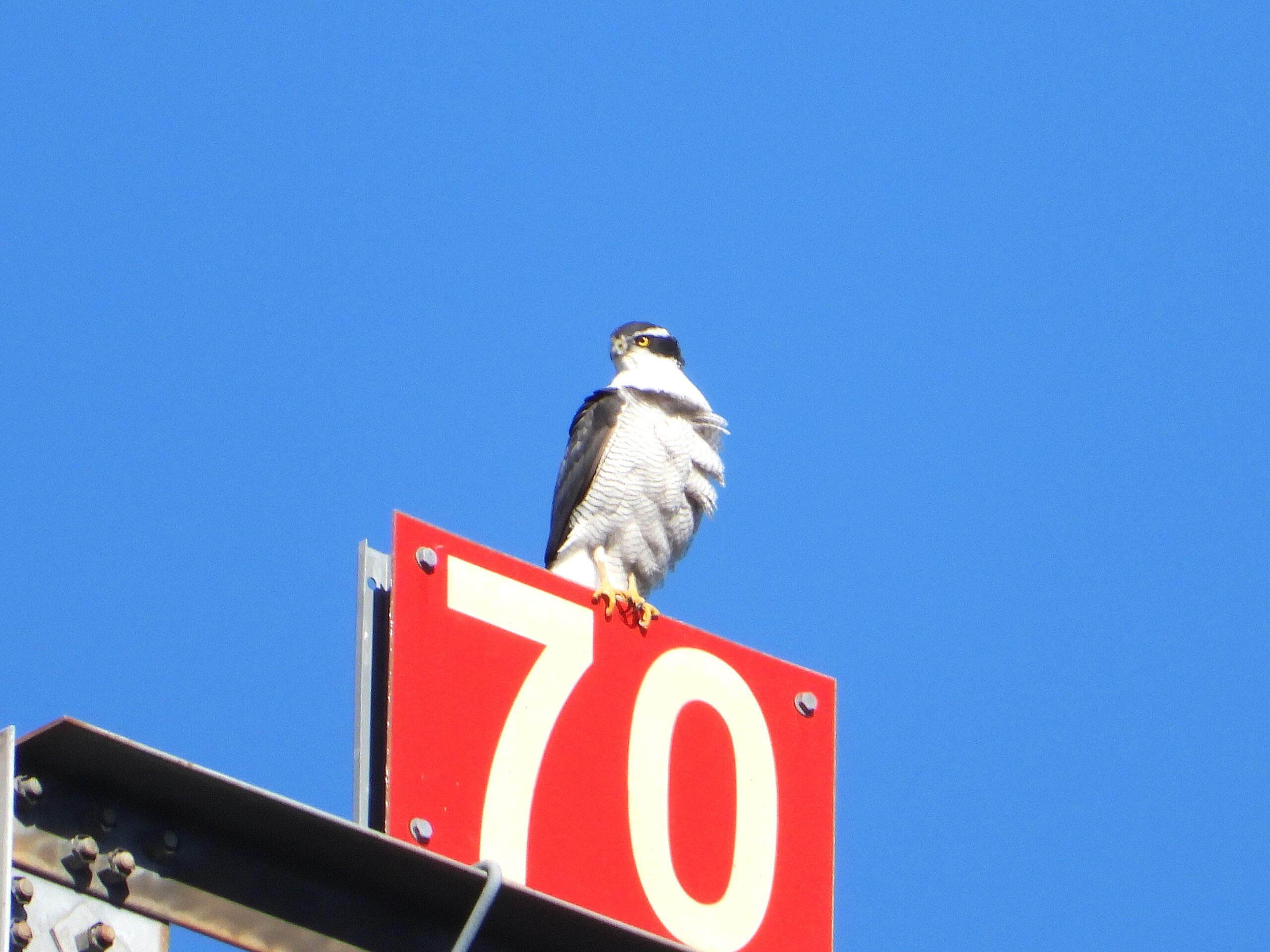
The Northern Goshawk has broad, rounded wings and a long tail, a body shape suited to agile flight through trees.
Adults typically show gray upperparts and finely barred underparts, with a pale eyebrow stripe that gives the face a sharp expression.
As in many birds of prey, females are larger than males. Exact body size varies among individuals, so this article avoids fixed measurements.
Habitat & Distribution
In Japan, the Northern Goshawk is mainly associated with forested environments.
It breeds primarily in woodland areas where suitable nesting trees are available, while also using nearby open or semi-open spaces for hunting.
The species occurs across much of Japan, with breeding confirmed mainly in Hokkaido, Honshu, and Shikoku. Outside the breeding season, it can be observed more widely, depending on regional conditions.
Where to See in Japan
The Northern Goshawk is not an easy bird to observe.
Your chances improve in areas that combine:
- Continuous forest suitable for nesting or roosting
- Adjacent open areas such as fields, forest edges, or river corridors
- Relatively low human disturbance
Sightings are often brief, as the species moves quickly and spends much time within forest cover.
Behavior
The Northern Goshawk is an ambush predator.
It typically hunts by accelerating suddenly from cover, using speed and surprise rather than long pursuits. This hunting style is closely linked to its forest-based habitat.
Some individuals in Japan are known to move seasonally, but movement patterns vary by region and individual, and not all birds migrate.
Diet
The diet of the Northern Goshawk in Japan consists mainly of other birds.
Small mammals may also be taken, depending on local availability. Prey composition can vary significantly between habitats and seasons.
Reproduction
Breeding activity begins from late winter to early spring.
Pairs build nests in trees within forested areas, and breeding success is closely linked to habitat quality and disturbance levels.
During the breeding season, adults are especially sensitive to repeated human approach near nesting sites.
Conservation
Globally, the Northern Goshawk is not considered threatened.
In Japan, however, it has long attracted conservation attention due to habitat loss and disturbance around nesting areas.
It is currently listed as Near Threatened on Japan’s national Red List, reflecting ongoing concern rather than immediate extinction risk. Continued protection of suitable forest landscapes remains important for the species’ long-term stability.
Author’s Impression
Seeing a Northern Goshawk is often a fleeting experience—a sudden shape cutting through the forest, then silence.
That brief encounter leaves a strong impression, reminding us that even familiar forests can still support top predators when the environment is allowed to function naturally.